About Banksia integrifolia L.fil.
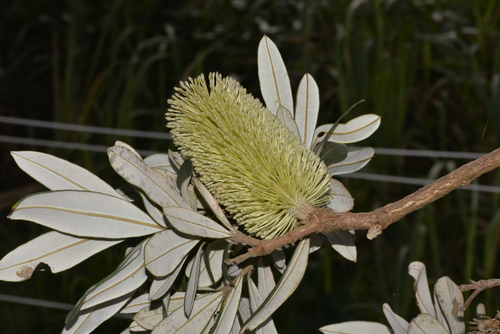
Banksia integrifolia L.fil. is a highly variable species. It most commonly grows as a tree up to 25 metres (82 ft) tall, but can reach 35 metres (115 ft) in sheltered locations. In more exposed areas, it may grow as a small, gnarled tree no taller than about 5 metres (16 ft), and in highly exposed sites such as exposed coastal headlands, it may even be a small shrub. The tree usually has a single stout trunk, which is often twisted and gnarled, with rough grey bark that is characteristic of Banksia. Its leaves are dark green with a white underside, and grow in whorls of three to five. Adult leaves have entire margins; George specifies their dimensions as 4–20 cm (1.6–7.9 in) long and 6–35 mm (0.24–1.38 in) wide, but The Banksia Atlas notes that "Atlas contributors found great variability in these measurements with specimens often falling outside the varietal limits specified by George (1981) or being intermediate between two varieties." Juvenile leaves have dentate margins with a few short teeth, and are generally larger than adult leaves. Flowers grow in Banksia's characteristic "flower spike", an inflorescence made of hundreds of flowers densely packed in a spiral around a woody axis. This structure is roughly cylindrical, 10–12 cm (3.9–4.7 in) high and 5 cm (2.0 in) wide. Flowers are usually pale yellow to yellow, but may be greenish or pinkish when in bud. Each individual flower has a tubular perianth made of four united tepals, and one long wiry style. As is characteristic of the taxonomic section it belongs to, the styles are straight rather than hooked. The ends of the styles are initially trapped inside the upper perianth parts, but break free at anthesis. This process starts with the flowers at the bottom of the inflorescence, moving up the spike at an unusually high rate of between 96 and 390 flowers per 24 hours. The flower spikes are not as prominent as in some other Banksia species, because they grow from two- to three-year-old nodes nested within the foliage. After flowering, old flower parts wither and fall away over several months, revealing the "cone", a woody axis embedded with many small follicles. The follicles are initially greenish and downy, but gradually fade to dark grey. Each follicle holds one or sometimes two seeds, separated by a thin wooden separator. The seed itself is black, 6–10 mm (0.24–0.39 in) long, with a feathery black 'wing' that is 10–20 mm (0.4–0.8 in) long. B. integrifolia is widely distributed across both a broad geographic and ecological range. According to Alex George, "it spans a wider geographical and climatic range than any other species." Thiele and Ladiges make a similar claim, noting its distribution "is a broader latitudinal, altitudinal and ecological amplitude than any other species, with the possible exception of B. spinulosa." No other tree species grows closer to the coast at Cape Byron, making B. integrifolia the most easterly tree on the Australian mainland. It occurs along almost the entire eastern coast of Australia, from Geelong, Victoria to Proserpine, Queensland. An isolated population was recorded on Long Island, Tasmania in 1999, and an 1876 record claims a finding from King Island, though there is speculation that specimen was actually collected in the Furneaux Group. The species no longer occurs at any of these Tasmanian locations, and it has been declared extinct in Tasmania under the state's Threatened Species Protection Act 1995. Its overall latitudinal range is approximately 20° to 38°S. For most of its distribution, B. integrifolia only occurs within about 50 km (31 mi) of the coast, where it typically grows on poor quality sandy soils derived from sandstone. It grows near coastal cliffs and headlands, alongside river estuaries, and even on stabilised sand dunes. The temperature range for this coastal area is around 0–30 °C (32–86 °F), with almost no frosts. The species can form pure stands, but is usually found growing alongside other species such as Melaleuca quinquenervia (broad-leaved paperbark), Angophora costata (smooth-barked apple), Corymbia gummifera (red bloodwood), Eucalyptus botryoides (bangalay), Monotoca elliptica (wedding bush) and Leptospermum laevigatum (coast tea tree). Between Sydney and Brisbane, B. integrifolia can be found up to 200 km (120 mi) inland, with B. integrifolia subsp. monticola occurring in the Blue Mountains at altitudes up to 1,500 m (4,900 ft). There it grows on better quality volcanic or rocky soils derived from granites and basalts, and experiences up to 100 frosts per year. In this montane habitat, it occurs alongside Eucalyptus species such as E. viminalis (manna gum) and E. pauciflora (snow gum), as well as rainforest species such as Nothofagus moorei (Antarctic beech) and Orites excelsa (prickly ash). Like most other Proteaceae, B. integrifolia has proteoid roots: roots with dense clusters of short lateral rootlets that form a mat in the soil just below the leaf litter. These roots improve the solubilisation of nutrients, allowing the plant to take up nutrients in low-nutrient soils such as the phosphorus-deficient native soils of Australia. Studies on B. integrifolia suggest its proteoid root mat achieves this by chemically modifying its surrounding soil environment. B. integrifolia flowers have an unusually short lifespan for Banksia species, producing nectar for only about four to twelve days after anthesis. Most nectar is produced during the night and early morning, with only small amounts produced during the day. Flowers are produced year-round, but there is a strong peak in autumn. Few other plants in its range flower at this time, so it is a seasonally important source of food for nectar-feeding animals. Surveys have recorded a wide range of animals feeding on the species, including many different insects; many bird species including Phylidonyris novaehollandiae (New Holland honeyeater), Anthochaera carunculata (red wattlebird), Anthochaera chrysoptera (little wattlebird), Acanthorhynchus tenuirostris (eastern spinebill) and Trichoglossus moluccanus (rainbow lorikeet); and mammals such as Petaurus norfolcensis (squirrel glider), Petaurus breviceps (sugar glider), Acrobates pygmaeus (feathertail glider), Pteropus poliocephalus (grey-headed flying fox), and Syconycteris australis (common blossom bat). In some areas such as Bungawalbin National Park in northern New South Wales, B. integrifolia is the only source of nectar and pollen in autumn (March–April) and late winter (July). The importance of non-flying mammals for pollinating B. integrifolia was demonstrated in 1989, when a study at Wilsons Promontory National Park showed reduced fruit set when these mammals were excluded. Banksia integrifolia is the host plant for the lichen species Arthonia banksiae. Microscopic Eriophyid mites (Eriophyidae) cause galls on the young infructescences of B. integrifolia. Unlike most Banksia species, B. integrifolia does not require bushfire to trigger the release of its seeds. Instead, seeds are released spontaneously when they reach maturity in late summer. The species' lack of reliance on fire for seed release suggests that excluding fire would not affect plant populations, but multiple studies have found the opposite to be true: in areas where fire has been excluded for many years, populations have declined substantially. An investigation into defoliation and premature death of trees on the Yanakie Isthmus in south Victoria reached the tentative conclusion that the absence of fire had created unhealthy surface soil conditions. On the Mornington Peninsula, surveys of an area that had not been burnt since the 1890s found that B. integrifolia densities fell by 77% between 1977 and 2000. A later study found the decline was caused by extremely high seedling mortality rates, due to grazing by herbivores and intense competition for soil moisture during summer. Despite acknowledging that "the role of fire in these systems remains unclear", it concluded that "developing fire and/or grazing management regimes will be necessary to conserve the structural integrity of these coastal ecosystems." Despite these conservation concerns, B. integrifolia does not appear to be under threat. It is highly resistant to Phytophthora cinnamomi dieback, which is a major threat to many other Banksia species; its wide distribution also protects it from the threat of habitat loss from land clearing. As a result, it does not appear on Australia's list of threatened flora under the Environment Protection and Biodiversity Conservation Act 1999. Hardy and versatile, B. integrifolia will grow in clay, sand, acid, and even alkaline soils, and has good resistance to wind and salt, making it suitable for seaside planting. It is therefore highly regarded as a low-maintenance garden tree, though its large size makes it unsuitable for smaller gardens. Its hardiness may however indicate weed potential, as some evidence of weediness has been recorded in South Africa, Western Australia and New Zealand. When growing near bushland within its native habitat, it is recommended to source plants from local provenance if available. The most common form available in commercial nurseries is unimproved Banksia integrifolia subsp. integrifolia. It prefers a sunny position without exposure to frosts, and tolerates fairly heavy pruning. Seeds do not require any treatment, and take 5 to 6 weeks to germinate. Flowering begins at around four to six years after sowing seed. The other subspecies are less well known in cultivation, but can be obtained. Cultivation is presumably similar to B. integrifolia subsp. integrifolia, except that B. integrifolia subsp. monticola may be assumed to be frost-tolerant. Dwarf forms of B. integrifolia are sometimes sold, and a registered prostrate cultivar, Banksia 'Roller Coaster', is available. The latter is a vigorous ground-hugging plant that can spread to 4 or 5 metres (13 or 16 ft) across while remaining only 50 cm (20 in) high. Because of its high resistance to P. cinnamomi dieback, the feasibility of using B. integrifolia as a rootstock for susceptible Banksia species in the cut flower trade is currently under investigation. Presently, the success rate for grafting is only 30–40%, and even successful grafts tend to have the graft union fail under stress. More research is needed before the technique will be ready for commercial use. The wood of B. integrifolia ranges from pink to red, with inconspicuous growth rings and conspicuous rays. It is spongy and porous, with a density of around 530 kg/m3 (33 lb/cu ft). It is considered highly decorative, but warps badly during drying, has poor load-bearing properties, and is susceptible to termite attack; it is therefore unsuitable for most construction purposes. It is sometimes used for cabinet panelling and in ornamental turnery, and natural bends were once sought after for making boat knees. It is a useful firewood. B. integrifolia produces a dark amber-coloured honey of middling quality, and therefore has low commercial value. Despite this, the species is highly valued by beekeepers because it produces large amounts of pollen and nectar during autumn and winter, helping support hives at a time when little else is flowering. Historically, Indigenous Australians obtained nectar from B. integrifolia by stroking the flower spikes then licking their hands, or by steeping flower spikes in a coolamon overnight. They also used the flower spikes as hairbrushes. Early settlers used the nectar as a syrup to treat sore throats and colds; and bushmen would soak barren "cones" with fat to make slow-burning candles. More recently, B. integrifolia has been used in the art of bonsai. Its rangy growth habit and long internodes are challenging to work with, but the leaves do reduce in size with pruning, and unlike the more gnarled B. serrata (saw banksia), its trunk can become textured with age. It is used as the floral emblem by two local government areas of Queensland: the City of Redcliffe and the City of Logan. In 2000 it was featured on an Australian postage stamp.