About Banksia fraseri (R.Br.) A.R.Mast & K.R.Thiele
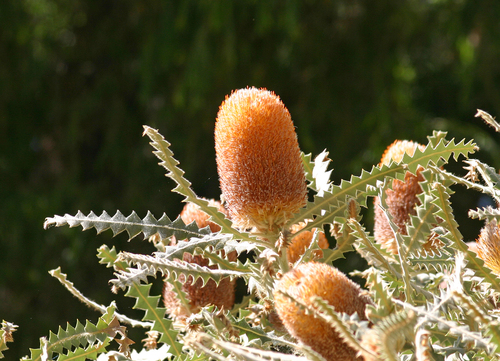
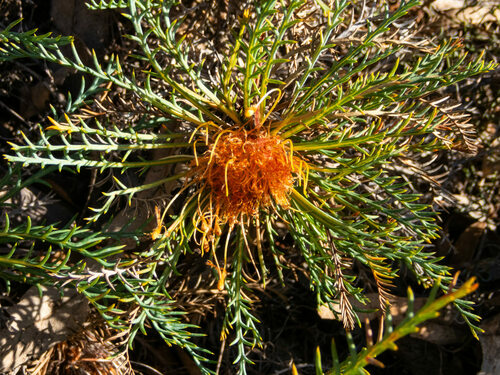
Banksia fraseri has a variable growth habit across its varieties: varieties B. fraseri var. crebra and B. fraseri var. effusa are very low, almost prostrate lignotuberous shrubs, while B. fraseri var. oxycedra is an upright non-lignotuberous shrub that grows up to six metres high. Young stems are covered in a mat of coarse hairs, which are shed as the stems mature. Leaves are 5–10 centimetres (2.0–3.9 in) long and 8–40 millimetres (0.31–1.57 in) wide. They are pinnatisect, with 4 to 18 narrow lobes on each side, and borne on a petiole up to 3 millimetres (0.12 in) long. Flowers form the dome-shaped heads characteristic of B. ser. Dryandra. These heads grow at the end of branches or on short lateral branches, and contain 80 to 100 individual flowers densely packed together, surrounded by a short involucre of narrow, tapering bracts. The hairless tips of these bracts are quite prominent, which is a distinctive feature of this species. Like all Proteaceae, individual flowers have a tubular perianth made of four united tepals fused with the anthers, and one long wiry pistil. The tip of the pistil is initially trapped inside the upper perianth parts, but breaks free at anthesis. In B. fraseri, the perianth is 24–28 millimetres (0.94–1.10 in) long, and ranges in colour from pink to cream; the style is 30–42 mm (1.2–1.7 in) long and cream-coloured. The fruit is a woody follicle firmly embedded in the woody base of the flower head, and usually holds two winged seeds. Each flower head of this species may produce an unusually large number of follicles. This species is distributed from Kalbarri in the north to Cranbrook in the south, and extends inland as far as Kellerberrin. It grows in shrubland, woodland and kwongan.