About Banksia baxteri R.Br.
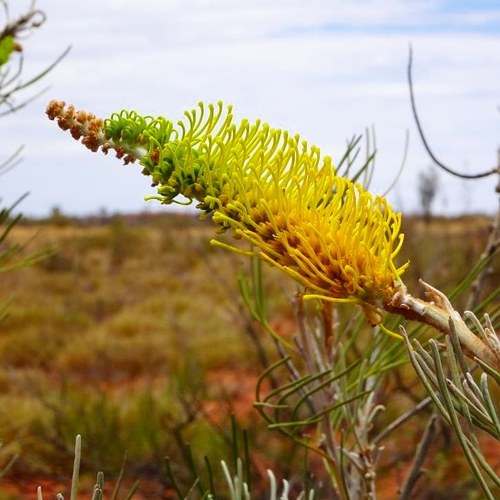
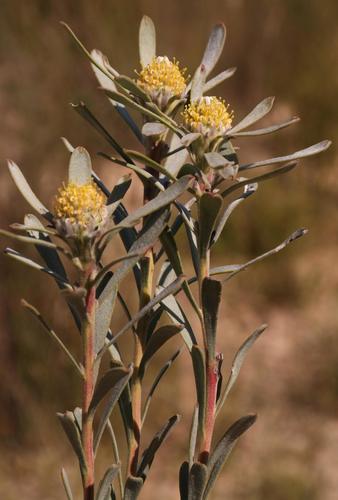
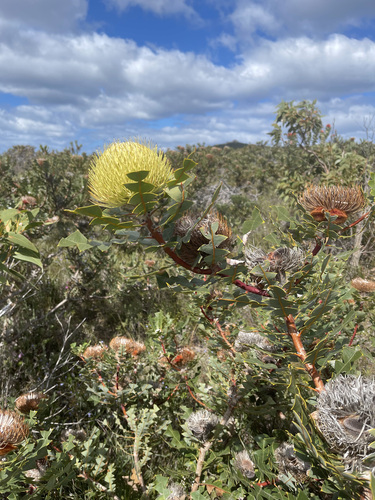
Banksia baxteri R.Br. is an erect shrub that usually reaches a height of 1 to 5 metres (3 feet 3 inches to 16 feet 5 inches), and does not form a lignotuber. When young, its branchlets and leaves are densely covered with woolly white hairs. Its leaves are wedge-shaped, with an overall outline 70 to 170 millimetres (2.8 to 6.7 inches) long and 25 to 75 millimetres (0.98 to 2.95 inches) wide, growing from a 5 to 15 millimetre (0.20 to 0.59 inch) petiole. The leaves are divided toward the midrib, with between four and seven triangular lobes on each side separated by V-shaped gaps. Flowers are arranged in a broad oval-shaped inflorescence 75 to 86 millimetres (3.0 to 3.4 inches) wide, borne at the ends of branches. Individual flowers are lemon-yellow, with a 39 to 43 millimetre (1.5 to 1.7 inch) perianth and a 42 to 49 millimetre (1.7 to 1.9 inch) pistil. Flowering occurs from December to May, with most flowering happening from January to March. Only a small number of follicles develop, surrounded by retained old flowers. These follicles are 35 to 42 millimetres (1.4 to 1.7 inches) long, 17 to 22 millimetres (0.67 to 0.87 inches) high, and 15 to 20 millimetres (0.59 to 0.79 inches) wide. Baxter's banksia grows alongside other shrubs including Lambertia inermis, usually in deep sand. It is mostly found within 50 kilometres (31 miles) of the coast, between East Mount Barren and Israelite Bay. A 1980 field study conducted at Cheyne Beach found this species is pollinated by the New Holland honeyeater and the white-cheeked honeyeater. Banksia baxteri is serotinous, meaning it stores an aerial seed bank in its canopy within the follicles of old flower spikes. These follicles open after fire, releasing large quantities of seed that germinate and grow after rain. Seed can remain viable for many years; seeds from old spikes 9 to 12 years old have been found to be 100% viable. For horticultural use, the seeds do not require any treatment and germinate within 21 to 42 days after sowing.