About Banksia baueri R.Br.
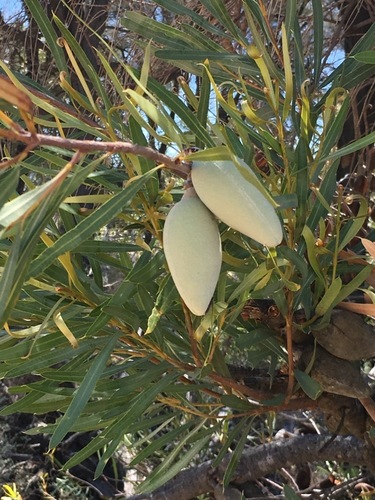
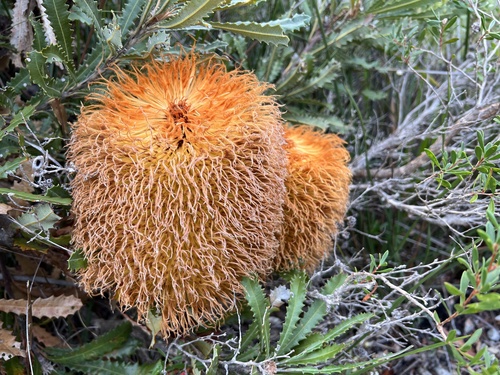
Banksia baueri R.Br. grows as a many-branched spreading shrub, reaching 0.5–2 m (1 ft 8 in – 6 ft 7 in) in height and 3 m (9.8 ft) in width, and it does not form a lignotuber. Its bark is thin, grey, and marked with long fissures, while new growth is covered in fine pale brown fur. New growth emerges in summer. The leaves are usually narrowly egg-shaped, with the narrower end positioned toward the base. They measure 40–130 mm (1.6–5.1 in) long and 5–35 mm (0.20–1.38 in) wide, have serrated edges, and taper to a 5–10 mm (0.20–0.39 in) long petiole. The inflorescence develops over 5 to 6 months, can reach 120–130 mm (4.7–5.1 in) in diameter and 170 mm (6.7 in) in height, and is borne on a short side branch. The flowers are cream, yellow, or brown, and covered in hairs. The perianth is 50–70 mm (2.0–2.8 in) long, and the pistil is 50–58 mm (2.0–2.3 in) long with a glabrous style. The fruit is a hairy, elliptical follicle that is 12–17 mm (0.47–0.67 in) long. This species is native to southern Western Australia, where it occurs in three separate disjunct areas: from Bremer Bay in the east to Jerdacuttup, on the southern Stirling Plains, and inland to the northwest between Kweda and Tarin Rock. It grows in shrubland or mallee, on flat or gently sloping ground, in white or grey sand, or in shallow sand that sits over laterite or quartzite. A 1985–1986 field study conducted in Fitzgerald River National Park found that Banksia baueri is a main winter food source for the nectar-feeding honey possum (Tarsipes rostratus). In horticulture, its unusual flower spikes are considered an attractive feature. Cultivated plants require well-drained soil and grow in full sun or part shade. Its seeds do not need any treatment before planting, and germinate in 20 to 49 days.