About Banksia attenuata R.Br.
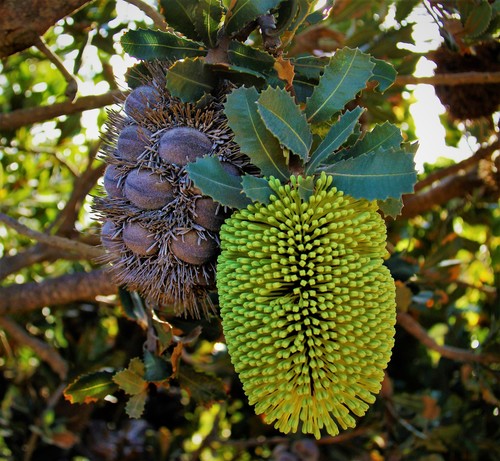
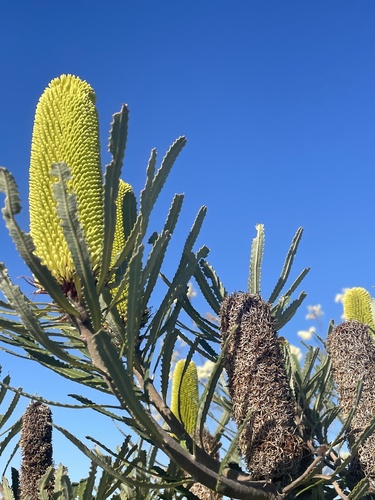
Banksia attenuata R.Br. most commonly grows as a tree up to 10 m (30 ft) tall. In the warmer, drier northern part of its range, it often grows as a stunted multistemmed shrub reaching 0.4 to 2 m (1.3 to 6.6 ft) tall. Both growth forms occur near the Hill River, with a clear demarcation of forms elsewhere. In the Wheatbelt and east of the Stirling Range, it grows as a stunted tree. Tree forms have a solid, generally wavy or bent trunk, with 1–2 cm (0.4–0.8 in) thick crumbly orange-grey bark that is red-brown underneath. It regenerates after fire from a lignotuber or from epicormic buds on its fire-tolerant trunk. It produces long, narrow, shiny green linear leaves that are 4 to 27 cm (1.6 to 10.6 in) long and 0.5 to 1.6 cm (0.2 to 0.6 in) wide, with V- or U-shaped serrations along the leaf margins. New growth is pale grey-green, and emerges mainly in late spring and summer, often after flowering. Brilliant yellow inflorescences (flower spikes) develop from spring through summer, growing up to 5 cm (2.0 in) wide and 25–30 cm (9.8–11.8 in) tall. Each inflorescence is made of many small individual flowers: a study at Mount Adams, 330 km (210 mi) north of Perth, counted an average of 1933 (± 88 standard error) flowers per inflorescence, while a study in Fitzgerald River National Park counted an average of 1720 (± 76) flowers. Anthesis (flower opening) progresses up the flower spike over 10 to 20 days, and is asynchronous: a single plant produces flower spikes over several weeks, so it holds spikes at different stages of development through the flowering season. Inflorescences are often bright green when in bud, grow terminally at the ends of one- to three-year-old branches, and are displayed prominently above the foliage. The scent of open flowers has been compared to peppery Shiraz wine. Over time, the spikes fade to brown then grey, and individual flowers shrivel against the spikes. This coincides with the development of dark furry oval follicles, which measure 2–3.5 cm (0.8–1.4 in) long, 1–1.5 cm (0.4–0.6 in) high, and 1.4–2 cm (0.6–0.8 in) wide. Only a very small percentage (0.1%) of flowers develop into follicles; the Mount Adams field study counted an average of 3.6 ± 1.2 follicles per cone. Follicles develop and mature over seven to eight months, from February to December, while seed development occurs over four months from September to December. Banksia attenuata is the most widely distributed of all western banksias, growing across a broad area of southwestern Western Australia. Its range extends south from Kalbarri National Park and the Murchison River (with an outlying population in Zuytdorp Nature Reserve) to Augusta and Cape Leeuwin at the southwestern corner of the state, then east across the south coast to the western edge of Fitzgerald River National Park. Further north along the eastern edge of its range, it occurs at Lake Grace, Lake Magenta north of Jerramungup, and the Wongan Hills. It is restricted to various sandy soils, including white, yellow, or brown sands, and sand overlying laterite or limestone. It is an important component of open Eucalyptus woodland, where it grows as a dominant or understory tree or tall shrub. Further north, it grows as a shrubby component of shrubland. It does not grow on heavy clay-based soils, so it is only found in sandy pockets. Within open woodland, it grows alongside B. menziesii, B. ilicifolia, B. prionotes, Allocasuarina fraseriana, Eucalyptus marginata, and E. gomphocephala. Annual rainfall across its distribution ranges from 300 to 900 mm (12 to 35 in). Like many plants in southwestern Western Australia, B. attenuata is adapted to a relatively frequent bushfire regime. Most Banksia species fall into one of two broad groups based on their fire response: reseeders are killed by fire, which triggers the release of their canopy seed bank to promote recruitment of the next generation; resprouters survive fire and resprout from a lignotuber, or more rarely from epicormic buds protected by thick bark. B. attenuata is a resprouter, with both epicormic buds and a lignotuber, and its follicles may open spontaneously or in response to fire. It is moderately serotinous, storing only one-tenth the number of seeds in its seed bank as the reseeding B. hookeriana, which it coexists with on sand dune scrub at Eneabba north of Perth. Even after fire, many of its follicles do not release seed until after successive autumn rains. An experiment simulating post-fire wet weather heated B. attenuata follicle cones to 500–600 °C (932–1,112 °F) for two minutes over a Bunsen flame, then immersed the cones in water twice weekly. Cones exposed to water for more weeks released more seed over time: around 40% of seeds were released at three weeks, rising steadily to almost 90% at ten weeks. By comparison, fewer than 10% of seeds were released from control cones that were heated but kept dry. This pattern means seed remains in follicles until successive rains bring dispersal in the wetter winter, rather than the drier summer, increasing the chance of seed survival. After a follicle splits, the seed and its separator are exposed to the elements. The wings of the woody separator are hygroscopic: they move together when wet, and spread and curl apart when dry. Seed is gradually drawn out by this movement with each wetting event. Once released, seed germinates at temperatures between 15 and 20 °C (59–68 °F), which aligns germination timing with autumn and winter rains to maximise survival chance. Even so, many seedlings die during the hot, dry summer months. Seedling survival for B. attenuata is lower than that of reseeding banksias over time. However, the longevity of mature plants allows populations to persist until favourable years support higher young plant survival. Mature plants are unlikely to perish once established, and are estimated to live for 300 years or more. Analysis of seed banks and 15 years of longitudinal data on the Eneabba sandplain found that B. attenuata becomes more abundant over time when average fire intervals fall between 6 and 20 years, peaking at intervals of 10 to 12 years. Reseeding species B. hookeriana and B. prionotes require longer fire intervals. B. attenuata is dominant between 8 and 10 or 11 years after fire, but is outcompeted by B. hookeriana at longer intervals. Variability in fire timing allows all three species to coexist. Extreme good and bad weather conditions favour B. attenuata over reseeding species, which suffer greater negative impacts. Despite having relatively heavy seed, B. attenuata seed has a high rate of long-distance dispersal. A genetic study of Eneabba populations found that over 5% of plants originated from up to 2.6 km (1.6 mi) away, a rate similar to B. hookeriana whose seeds weigh half as much. The mechanism for this dispersal is unclear, but Byron Lamont has proposed Carnaby's black cockatoo (Zanda latirostris) as a dispersal vector. The cockatoo seeks out B. attenuata cones after bushfire, possibly because the large seeds and higher chance of grubs in the cones make them more nutritious. Flowering has been recorded one to two years after bushfire. Like many members of the plant family Proteaceae, B. attenuata is an obligate outcrossing, self-incompatible species, meaning inflorescences require pollinators to be fertilised and produce seed. A 1980 genetic study of seed collected near Jandakot confirmed obligate outcrossing. A field study in Fitzgerald River National Park enclosed inflorescences in mesh fine enough to exclude vertebrates and invertebrates as small as the honey bee (Apis mellifera), but follicles still developed, showing that small invertebrates can cross-pollinate the species. B. attenuata flowers are visited by the colletid bee Hylaeus globuliferus and bees of the genus Euhesma. Other recorded pollinating invertebrates include ants and dragonflies. An analysis of invertebrate populations in Banksia woodland canopies found mites and ticks (Acari), beetles (Coleoptera), and ants, bees and wasps (Hymenoptera) were overall dominant, and these three orders were also the most common on B. attenuata, along with thrips (Thysanoptera). Lower overall invertebrate numbers on Banksia species are thought to be related to the presence of insectivorous birds. The national Banksia Atlas survey recorded many bird species visiting B. attenuata, including the New Holland honeyeater (Phylidonyris novaehollandiae), brown honeyeater (Lichmera indistincta), singing honeyeater (Gavicalis virescens), western spinebill (Acanthorhynchus superciliosus), twenty-eight parrot (Barnardius zonarius semitorquatus) and red-tailed black cockatoo (Calyptorhynchus banksii). Black cockatoos have been observed feeding on B. attenuata seed, though it is not clear whether this was the short-billed (Carnaby's) or long-billed black cockatoo (Calyptorhynchus baudinii). At a site near Jandakot, short-billed black cockatoos were observed selecting immature infructescences that showed signs of infestation by the weevil Alphitopis nivea, whose larvae tunnel in banksia spikes and eat seed. The cockatoos extract the larvae and drop the cones. A 1978 field study conducted around Albany found the honey possum (Tarsipes rostratus) is a major pollinator of B. attenuata, feeding directly on pollen and drinking nectar. The flower structure is suited to depositing pollen onto feeding honey possums, unlike for honeyeaters whose bills are too long for this to happen easily. Combined with the flower spike's musky odour, these findings suggest B. attenuata is highly adapted to be primarily pollinated by this mammal species. Petroc Sumner and colleagues investigated the cone photoreceptor cells of honey possums and compared them to the colour changes of B. attenuata. They found honey possums are trichromatic (like humans and possibly many marsupials), and propose that their L (long wavelength) cones help them detect B. attenuata flower spikes, while their M (medium wavelength) cones could help them distinguish nectar-bearing ripe inflorescences from recently finished spikes, a task that is difficult for human vision. There is some evidence for other mammals acting as pollinators: B. attenuata-like pollen was recovered from museum skins of dunnarts (Sminthopsis spp.) and pygmy possums (Cercartetus spp.), and sugar gliders (Petaurus breviceps) visited flower spikes in captivity. Seventeen species of slime molds (myxomycetes) from several orders have been isolated from the bark of B. attenuata. Over half (nine) belong to the order Stemonitales, and Echinosteliales and Liceales are also common. The abundance of the first two orders may be due to the acidity of the bark. The order Physarales was unusually rare; other studies have shown this order is typically abundant on the bark of tree species around the world. Like all banksias, B. attenuata develops proteoid (cluster) roots in response to the nutrient-poor conditions of Australian soils, particularly soils low in phosphorus. These roots have been measured extending to 15 cm (5.9 in) below the soil surface at Eneabba. The plant develops masses of fine lateral roots that form a mat-like structure just below the soil surface, enabling it to extract nutrients as efficiently as possible. A study of three co-occurring species in southwestern Australian Banksia woodland—B. menziesii, B. attenuata and B. ilicifolia—found that all three develop fresh roots in September after winter rainfall, that the bacteria communities associated with B. menziesii root systems differ from those of the other two species, and that bacteria communities also change with root age. Another study of root architecture in B. hookeriana, B. menziesii and B. attenuata found the overall root structure of all three was similar, with proteoid mats more active and growing during wetter winter-spring months. Plants grow several sinker roots that descend to reach the water table, and the original tap root may or may not have died back. Along with B. menziesii, B. attenuata is a facultative phreatophyte. The two species are less strictly tied to the water table, so they can grow in a wider range of locations within Banksia woodland around Perth than co-occurring B. ilicifolia and B. littoralis. A study at a sand mine rehabilitation site north of Perth found that the broadleaved species B. attenuata and B. hookeriana were harder to establish than fine-leaved B. leptophylla, due to increased soil impedance in the disturbed soil. Analysis of native plant species at a remnant Banksia woodland in suburban Perth, which had been invaded by two herbaceous weed species (Ehrharta calycina and Pelargonium capitatum), found increased phosphorus levels in the foliage of native plants. While B. attenuata leaves did not have increased phosphorus, they did have reduced manganese levels; manganese is absorbed by the plant's proteoid roots, whose formation can be inhibited by raised phosphorus levels. In a 1985 study inoculating cultivated plants, B. attenuata showed moderate to high susceptibility to Phytophthora cinnamomi dieback, and some field and cultivation evidence indicates it is highly susceptible. P. cinnamomi spreads from plant to plant via lateral roots, advancing at a rate of around one metre per year. Symptoms of infection in B. attenuata include yellowing of leaves in the tree crown and lesions at the base of the trunk. Healthy red roots turn a discoloured brown. A 16-year study of B. attenuata woodland 400 km (250 mi) southeast of Perth, conducted after a wave of P. cinnamomi infestation, showed that B. attenuata populations still persisted but were significantly reduced in diseased areas. Injecting a phosphite solution into the trunks of affected B. attenuata trees at a disease front in Banksia woodland can delay dieback morbidity for five years. Both trunk injection and foliar spraying of phosphite also reduces the spread rate of a dieback front for around five years, and a bushfire did not affect this slowing. A 2003 study found that drenching soil with 0.50 mM benzoic acid significantly reduces the size of P. cinnamomi lesions. Research into dieback in Western Australia identified a new species, P. multivora, isolated from ailing eucalypts and B. attenuata in 2009. In horticulture, the prominently displayed bright yellow spikes of B. attenuata are an attractive feature, and shrubby dwarf forms are more versatile for cultivation. All forms require good drainage, sandy soil, and a sunny position to grow well, with a soil pH between 5.5 and 7.0. They are sensitive to dieback and do not grow well in humid climates. Seeds require no treatment before sowing, and germinate in 16 to 49 days. Seedlings are highly vulnerable to damping off. Plants take four to six years to flower from seed. There has been little success with grafting or other methods to improve adaptability to humid climates. Late bud flower spikes are used in the cut flower industry, primarily in Western Australia. Aboriginal people, particularly the Nyoongar and Yamatji, historically placed flower spikes in paperbark-lined holes filled with water to make a sweet drink. Both B. attenuata and B. aemula have been credited as the inspiration behind May Gibbs' Big Bad Banksia Men; Gibbs was familiar with this species during her childhood and it likely gave her the initial inspiration, though Gibbs' depictions resemble B. aemula. Artist Marianne North produced a well-regarded painting of B. attenuata during her stay in Australia in 1880–1881.