About Banksia aemula R.Br.
Banksia aemula, commonly called wallum banksia, is generally a gnarled shrub or small tree that usually reaches less than 8 m (26 ft) tall. However, individual specimens growing in forest on North Stradbroke Island have been recorded between 8.3–12.1 m (27–40 ft) high, with a maximum diameter at breast height of 44 cm (17 in). Its trunk has thick, orange-brown, wrinkled, warty bark. New growth is hairy when young, and becomes smooth with age. New shoots grow in spring and summer.
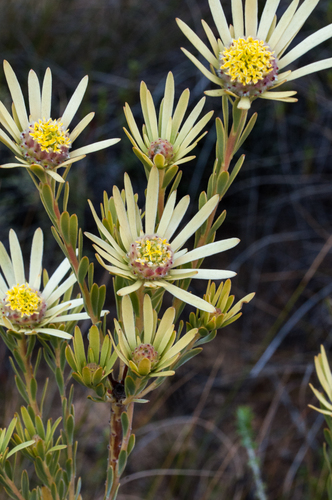
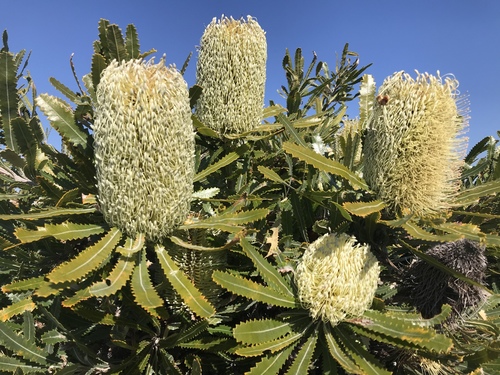
Its shiny green leaves are obovate to oblong in shape, measuring 3–22 cm (1.2–8.7 in) long and 1–2 cm (0.4–0.8 in) wide. Leaf tips are truncate, with flat, serrated margins. Flowering occurs in autumn, from March to June. Its green-yellow terminal flower spikes, called inflorescences, grow at the ends of branches and emerge from foliage. These spikes measure 4 to 20 cm (1.6 to 7.9 in) tall and 8 to 9 cm (3.1 to 3.5 in) wide, and display various shades of pale and greenish yellow. Between 800 and 1700 individual small flowers grow from a central woody spike called a rachis. Unopened flowers have white conical pollen presenters at their tips, and flowers open sequentially from the bottom to the top of the spike over one to two weeks, a process called sequential anthesis. Each flower produces nectar for approximately seven days after opening. As flower spikes age, they turn grey, and up to 25 finely furred grey follicles develop. These follicles can be quite large, measuring 3–4.5 cm (1.2–1.8 in) long, 2–3.5 cm (0.8–1.4 in) high, and 2–3.5 cm (0.8–1.4 in) wide. They split open either after bushfire or spontaneously, and release oval seeds that are 4–4.7 cm (1.6–1.9 in) in total length. Each seed consists of a 1–1.5 cm (0.4–0.6 in) long wedge-shaped body 1.1–1.6 cm (0.4–0.6 in) wide, attached to a curved wing 2–3.2 cm (0.8–1.3 in) wide. Banksia aemula resprouts from its woody lignotuber after fire.
This species closely resembles Banksia serrata, but B. serrata can be distinguished by its greyer (not orange-brown) trunk, adult leaves wider than 2 cm (0.8 in), duller grey-yellow inflorescences, longer 2–3 mm fusiform (spindle-shaped) or cylindrical pollen presenters on unopened flowers, and smaller follicles.
Banksia aemula is native to the east coast of Australia, ranging from approximately 70 km (43 mi) north of Bundaberg in central Queensland south to Sydney. Its southernmost known occurrence is at La Perouse, on the northern side of Botany Bay. It is also found on Fraser, Moreton, and North Stradbroke Islands. Almost all populations grow within a few kilometres of the coast; exceptions include one population at Agnes Banks in western Sydney, two populations just north and south of Grafton at Coaldale and Glenreagh, and one around 30 km (19 mi) southwest of Bundaberg.
It most commonly grows in deep sandy soils, on dunes or flat areas that may be seasonally wet. On coastal dunes in southern Queensland, it replaces Banksia serrata, which occupies the same ecological niche further south. These open woodland or heathland areas are known as wallum. In Queensland, it grows alongside Banksia robur, where B. robur occupies flatter wetter areas and B. aemula grows on rises. It also grows with Banksia oblongifolia in Queensland. In some wallum areas, it may grow as a small tree alongside mallee forms of red bloodwood (Corymbia gummifera). In Cooloola National Park, it is an occasional emergent plant alongside Melaleuca quinquenervia and Eucalyptus umbra in closed graminoid heathland, a community of 0.5–2 m (1.6–6.6 ft) tall shrubs that also includes Xanthorrhoea fulva, Empodisma minus, Petrophile shirleyae, and species of Hakea and Leptospermum. On the New South Wales Central Coast, it generally grows as a 1–2 m (3.3–6.6 ft) tall shrub and forms part of the canopy of Banksia aemula open heathland, located on coastal headlands on highly leached Pleistocene white sands overlying Triassic and Permian strata. Recorded locations include Wybung Head in Munmorah State Conservation Area, and areas near Myall Lakes. Associated plant species here include Ricinocarpos pinifolius, Brachyloma daphnoides, Dillwynia glaberrima, D. retorta, Allocasuarina distyla, Bossiaea ensata, Aotus ericoides, Phyllota phylicoides, and Empodisma minus. Sandmining has eradicated most of this community around Redhead. In less leached yellower sands, this community (and B. aemula) is replaced by taller heath containing B. serrata and B. oblongifolia.
At the southern end of its range, B. aemula is a component of the Eastern Suburbs Banksia Scrub, an endangered ecological community that grows on younger windblown sands than the heathlands further north. The Agnes Banks Woodland in western Sydney, also recognised as an Endangered Ecological Community by the New South Wales Government, hosts B. aemula as an understory plant in low open woodland. Here, canopy trees are scribbly gum (Eucalyptus sclerophylla), narrow-leaved apple (Angophora bakeri) and B. serrata, and other understory species include B. oblongifolia, Conospermum taxifolium, Ricinocarpos pinifolius, Dillwynia sericea and nodding geebung (Persoonia nutans). On North Stradbroke Island, B. aemula is one of three canopy tree species in 12–15 m (39–49 ft) high forest dominated by Eucalyptus signata, alongside Eucalyptus umbra. This forest grows on a 100 m (330 ft) high ridge formed from an ancient sand dune, where bracken (Pteridium esculentum) dominates the understory. Other associated tall shrubs include Persoonia cornifolia and Acacia concurrens.
Like all Banksia species, including B. aemula, this species has proteoid roots: roots with dense clusters of short lateral rootlets that form a mat in soil just below leaf litter. These roots are especially efficient at absorbing nutrients from the nutrient-poor, phosphorus-deficient native soils of Australia. A study of six wallum species including B. aemula found it has adapted to very low phosphorus levels and is highly sensitive to increased phosphorus, which causes phosphorus toxicity. There is some evidence it is efficient at using potassium, and also sensitive to calcium toxicity. A field study on North Stradbroke Island noted increased root growth in autumn (around April), and overall root growth was more consistent than in other studied species, likely due to its deeper roots having more regular access to groundwater.
A 1998 study in Bundjalung National Park, northern New South Wales, found B. aemula inflorescences are foraged by a variety of small mammals, including marsupials such as the yellow-footed antechinus (Antechinus flavipes), and rodents such as the pale field rat (Rattus tunneyi), Australian swamp rat (Rattus lutreolus), grassland melomys (Melomys burtoni) and even the introduced house mouse (Mus musculus). These animals carry pollen loads comparable to those of nectarivorous birds, making them effective pollinators. Grey-headed flying foxes (Pteropus poliocephalus) have also been observed visiting B. aemula, and their heads and bellies contact stigmas while feeding. Bird species observed feeding at B. aemula flowers include the rainbow lorikeet, scarlet honeyeater, and Lewin's honeyeater. The Banksia Atlas recorded several other honeyeater species on B. aemula inflorescences: the New Holland honeyeater, brown honeyeater, white-cheeked honeyeater, tawny-crowned honeyeater, noisy miner, little wattlebird, and noisy friarbird. The Bundjalung study found the brown honeyeater carries much higher loads of B. aemula pollen than other measured species, including white-cheeked honeyeaters, yellow-faced honeyeaters, and silvereyes. Insects such as ants and bees (including the introduced honeybee) have also been recorded visiting inflorescences.
Banksia aemula resprouts from a lignotuber or shoots from epicormic buds after fire. Fire management for B. aemula heath in Southeast Queensland recommends fire intervals of 7 to 20 years. Intervals of 10–15 years are recommended for the Eastern Suburbs Banksia Scrub, as longer intervals lead to overgrowth by Leptospermum laevigatum.
Experiments on B. aemula seed germination and early growth confirmed phosphorus is toxic to seedlings: it inhibited growth at double normal soil concentrations, and caused seedling death at quadruple normal concentrations. Adding potassium or magnesium slightly reduced these toxic effects, though high potassium concentrations also negatively impacted growth. Overall, seedlings grow slowly over their first 21 weeks compared to other plant species; the reason for this is unclear, but it may increase survival chances in nutrient- or water-poor environments. Seed was killed by exposure to 150 °C (302 °F), but survived seven-minute exposure to 100 °C (212 °F).
A study of coastal heaths on Pleistocene sand dunes around Myall Lakes found B. aemula grows on ridges (dry heath) while B. oblongifolia grows on slopes (wet heath), and the two species do not overlap. Manipulation of seedlings in the same study area showed B. aemula grows longer roots to seek water, and seedlings can grow in wet heath, but it remains unclear why the species does not grow as well in wet heath as in dry heath. Unlike similar cases with Western Australian banksia species, the two species do not appear to negatively affect each other. A field study on seedling recruitment conducted at Broadwater National Park and Dirrawong Reserve on the New South Wales North Coast found B. aemula generally produces low numbers of seedlings, but seedling attrition is low, and seedlings have higher survival rates on dry than wet heaths. Field work including experimental seedling outplanting at Crowdy Bay National Park found B. aemula seedling roots reach the water table within six months of germination, and seeds can germinate both with and without recent bushfire. The pattern of bradyspory (fewer seeds with a higher survival percentage) is of unclear cause, but may be a defence against seed-eating animals. Similarly, field work on North Stradbroke Island noted B. aemula sheds its winged seeds gradually between and after fire events, and germinates and grows readily with little herbivore predation.
Three new fungal species have been described from B. aemula leaves collected in Queensland: Toxicocladosporium banksiae described in 2010 from 2009 collections in Noosa, Noosia banksiae (a new genus) also described in 2011 from 2009 Noosa collections, and Saitozyma wallum described in 2019 from a leaf collected on the Sunshine Coast.
Banksia aemula was one of the first banksias cultivated in England, first grown there in 1788, where it was illustrated in Curtis's Botanical Magazine and its rival, The Botanical Register. Its shiny green leaves, showy flower spikes, large follicles, and wrinkled bark make it an attractive ornamental plant. It also attracts birds and insects. Trials in Western Australia and Hawaii have shown B. aemula is resistant to Phytophthora cinnamomi dieback. It requires well-drained, slightly acidic soil with a pH of 5.5–6.5, preferably a fairly sandy texture and a full sunny position. Summer watering is recommended, as it does not tolerate water stress well. It is slow-growing, taking four to six years to flower from seed, and is less commonly cultivated than B. serrata. Research into optimum germination temperatures found best results occur with nighttime temperatures of 20–28 °C (68–82 °F) and daytime temperatures of 24–33 °C (75–91 °F), so summer planting is recommended. It has been used as rootstock for grafting Banksia speciosa, and has potential use in bonsai. Its red textured timber has been used for cabinet-making.