About Bangsia aureocincta (Hellmayr, 1910)
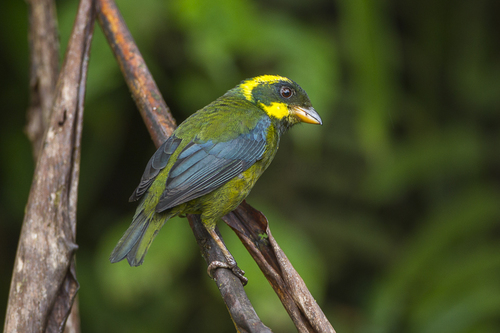
Like other Bangsia tanagers, the gold-ringed tanager (Bangsia aureocincta) is a plump bird with a relatively short tail. It measures approximately 16 cm in length and typically weighs between 35 and 45 grams. Adult individuals are mostly dark green with a yellow breast. Adults have prominent "gold ring" facial markings that make the species easy to identify; the only species it may be confused with is the slaty-capped shrike-vireo. F. Gary Stiles provided detailed descriptions of this species, based on individuals captured at Alto de Pisones in Risaralda Department.
This species occurs on the slopes of the western cordillera of the Andes. Its overall altitudinal range spans from 1350 to 2195 meters above sea level, though most individuals are found at or above 1700 masl. The only location where the species has been observed as low as 1350 masl is the area around San José del Palmar in Chocó Department; this is thought to be related to the absence of the black-and-gold tanager at this site. At any individual site, gold-ringed tanagers occupy a narrow altitude range of 100 to 200 meters, which matches the main cloud interception zone on the Pacific slope.
Very little was known about the gold-ringed tanager until recently, apart from four specimens collected between 1909 and 1949. Current research has confirmed the existence of three small populations located in the general area of the Tatamá massif (Cerro Tatamá), a 4100-meter peak in Chocó Department that is the highest point in the Western Andes. The first population occurs between the departments of Chocó, Valle del Cauca and Risaralda, in the Serranía de los Paraguas. This range includes sites such as the Cerro El Inglés Community Nature Reserve, and Alto de Galápagos near the road between San José del Palmar (Chocó) and the village of El Pacifico in the municipality of El Cairo (Valle del Cauca). The second population is centered around Cerro Montezuma (Montezuma mountain) within Parque Nacional Natural Tatamá. This range includes the Las Canary Islands site in the municipality of Pueblo Rico, and the Carramanta massif at Alto de Pisones in the Municipality of Mistrató. On Cerro Montezuma, gold-ringed tanagers are observed along Camino Montezuma, the road leading to the military base at the hill's summit, and also near the mining settlement in Quebrada Las Canarias on the mountain's western slope. The third confirmed population occurs within Antioquia Department, and includes the Mesenia-Paramillo Natural Reserve (RN) in the municipality of Jardín, Las Orquídeas National Natural Park, and the Las Tángaras ProAves Reserve in the municipality of El Carmen de Atrato.
Gold-ringed tanagers live in wet, mossy, mature or secondary Andean cloud forest with a canopy height between 9 and 12 meters. The areas they inhabit consist of continuous tracts of natural forest with little or no human intervention. They generally avoid fragmented forest, pastures, and human settlements. The species prefers very humid habitats: areas where it is common are frequently covered by orographic clouds for long periods each day, while it is less common in elevation zones where orographic clouds are only present half of each day on average.