About Bambusicola thoracicus (Temminck, 1815)
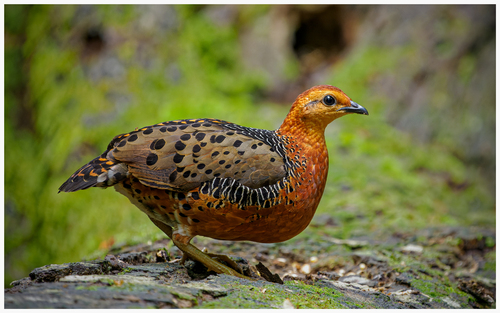
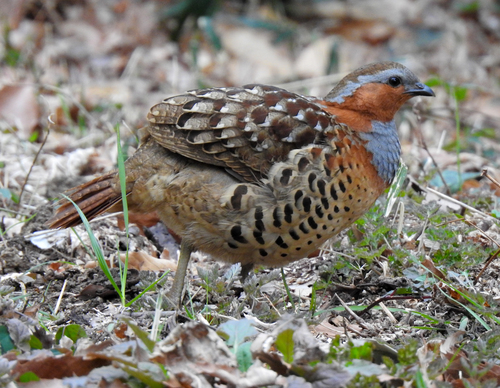
Description: The Chinese bamboo partridge (Bambusicola thoracicus) is a small bird whose size falls between that of Coturnix and Perdix species. It grows to a length of 31cm, with males slightly larger than females. Its breast and back are mottled in black, chestnut, and cream, with black spots on the flanks and upper parts of the body. The bird’s face and throat have rich fulvous and rufous tints. Its breast is yellow-ochre, and the areas above the eye extending down to the neck are pale greyish blue and taupe. Like the long-billed partridge, the Chinese bamboo partridge has well-developed flight feathers. Its tail is broad and squared, and its wings are long and narrow. This species is capable of sustained flight, and individuals move between steep hillside forest sub-canopy and the forest floor multiple times a day. Distribution and habitat: This bird is native to eastern mainland China, and has been successfully introduced to Japan, Hawaii, and Argentina. It lives in warm forests and grasslands, and despite its common name, it does not depend entirely on bamboo. The Taiwan bamboo partridge was formerly classified as a subspecies of Bambusicola thoracicus.