About Bambusa spinosa Roxb.
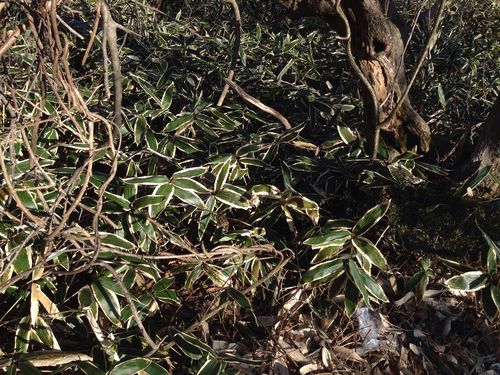
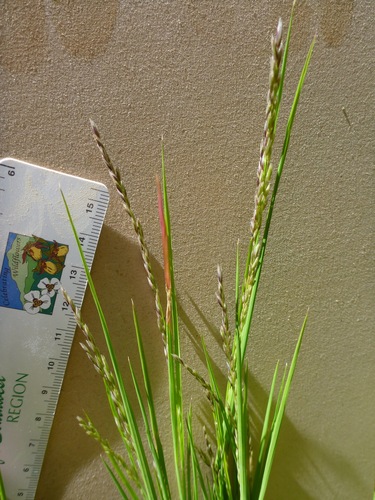
Bambusa spinosa Roxb. (also referenced as Bambusa blumeana) has culms (stems) that reach up to 25 m (82 ft) in length and are slightly arched. At the base, culms grow up to 15 cm (6 in) thick, with walls 2 to 3 cm (0.8 to 1.2 in) thick, and may even be solid. The stem is made up of a series of short sections separated by nodes. Main branches grow on the upper half of the culms, while the branches on the lower part of the culm are slender and covered in thorns. Its leaves are alternate, lanceolate, grow up to 20 cm (8 in) long, with one leaf produced per node; the lower portion of the leaf forms a sheath around the stem.
The origin of Bambusa blumeana is not clear, but it may be native to Indonesia and Borneo. Its current range includes the Philippines, Thailand, Vietnam, southern China and Japan. It has also been introduced to Madagascar, Guam, and other Indo-Pacific islands. Its natural habitat is hillsides, valley bottoms and stream banks, where it forms tangled thickets, at altitudes up to around 300 m (1,000 ft). It tolerates acid soils, clay soils, and occasional flooding, but cannot tolerate saline soils.
Young shoots of this bamboo are harvested when they first emerge from the ground, then boiled and eaten as a vegetable. The plant is used as a living fence between fields, a windbreak around homesteads, and to prevent erosion on river banks. The poles work well for lightweight scaffolding, but are not durable enough for general building construction; other uses for the poles include basket-making, furniture production, parquet, toys, chopsticks and kitchen utensils. Along with the culms of Dendrocalamus asper, the culms of this species are the main source of bamboo pulp used for paper making. Bambusa blumeana is sometimes cultivated as an ornamental plant.
This plant can be propagated from seed, but it only flowers once every several years, so seed is often not available. It can also be propagated by dividing clumps when new growth begins, or by cutting culms into sections to use as cuttings.