About Balearica pavonina (Linnaeus, 1758)
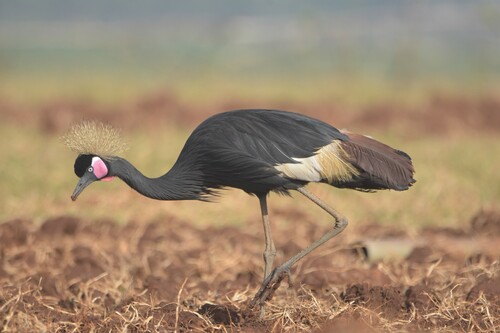
Balearica pavonina, commonly called the black crowned crane, can reach up to 105 cm (41 in) in body length, weigh 3,000–4,000 g (110–140 oz), and has a wingspan between 180–200 cm (71–79 in). Its naturally occurring plumage ranges from dark slate-grey to solid black, with a crown of stiff golden feathers on the top of its head. Each of the bristle-like golden feathers forms a spiral, with a white side, a brown opposite side, and a black tip. Other distinct physical features include white feathers on the upper sections of the wings, and a small pouch of red skin called the gular sac that hangs underneath the chin. Its long legs and toes are black, and it has a long hind toe that lets it grasp perches. The species also has large red cheek patches positioned just behind the eye, and the size and placement of the red area differs between its two recognized subspecies. For the West African black crowned crane (Balearica pavonina pavonina), red covers only the lower half of the cheek patch, while the Sudan black crowned crane (Balearica pavonina ceciliae) has red that extends into the upper half of the patch as well. Males are larger than females, but the two sexes are otherwise indistinguishable in appearance. Juvenile black crowned cranes are mostly grey overall, with a brown crown and nape, and a body that ranges from grey to brown. Black crowned cranes live across the Sahel and Sudan savanna regions of Africa, and inhabit open habitats including grasslands, shallow wetlands, marshes, and the margins of lakes and rivers. They are also known to roost in trees. The species’ full range stretches from the Senegal Basin and Guinea-Bissau Drainage in West Africa to the Ethiopian Highlands and South-West Rift Valley in East Africa. Balearica pavonina pavonina occupies the western portion of this total range, while Balearica pavonina ceciliae is found in the eastern portion, with the largest populations of this subspecies located in Sudan.