About Balaenoptera borealis Lesson, 1828
Taxonomic Naming
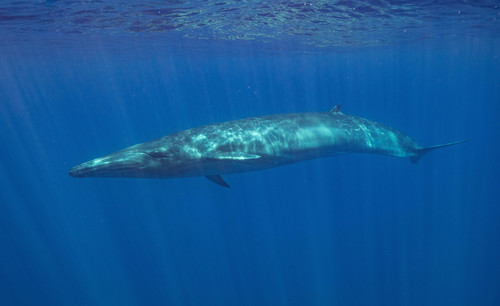
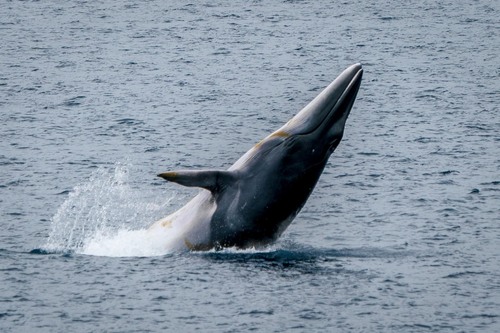
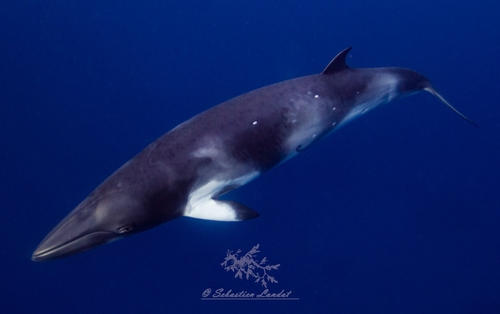
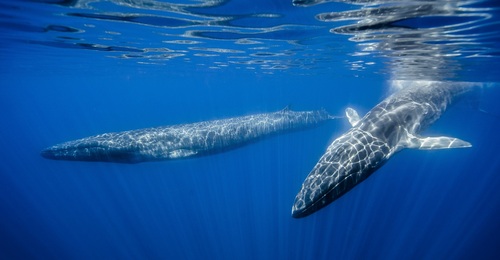
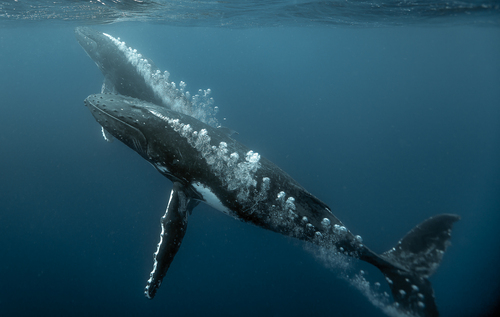
Balaenoptera borealis Lesson, 1828, commonly called the sei whale, typically has a dark steel grey body, with irregular light grey to white markings on its ventral surface, or toward the front of its lower body.
Ventral Groove Morphology
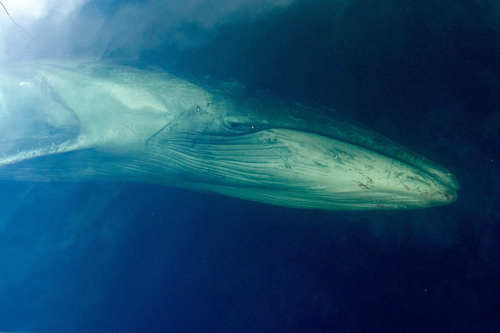
It has a relatively short series of 32 to 60 pleats or grooves along its ventral surface, which extend only halfway between the pectoral fins and umbilicus. In other related species, these grooves usually reach or extend past the umbilicus.
Groove Function Impact
This shorter groove length restricts the expansion of the buccal cavity during feeding compared to other species.
Rostrum and Pectoral Fin Traits
The sei whale has a pointed rostrum, and relatively short pectoral fins that make up only 9 to 10% of its total body length, with pointed tips.
Head Ridge Characteristic
A single solitary ridge runs from the tip of the rostrum to the paired blowholes, a distinctive trait of all baleen whales.
Skin Marking Causes
The whale’s skin is often marked by pits or wounds, which leave white scars after healing. These scars are confirmed to be caused by cookie-cutter sharks (Isistius brasiliensis).
Dorsal Fin Morphology
Sei whales have a tall, sickle-shaped dorsal fin that stands 38 to 90 cm (15 to 35 in) high, averaging 53 to 56 cm (21 to 22 in) in height, located approximately two-thirds of the way back from the tip of the rostrum.
Photo-Identification Markers
Dorsal fin shape, pigmentation pattern, and scarring have been used to a limited extent in photo-identification studies of the species.
Tail Morphology
The tail of a sei whale is thick, and its fluke (tail lobe) is relatively small for the whale’s overall body size.
Baleen Plate Traits
Adult sei whales have 300 to 380 ashy-black baleen plates on each side of the mouth, reaching up to 80 cm (31 in) long. Each plate is made of keratin, the same material as human fingernails, and is bordered by a fringe of very fine, short, curly, wool-like white bristles.
Distinctive Baleen Bristle Traits
The sei whale’s baleen bristles are very fine, highly calcified, and stiff, measuring only about 0.1 mm (0.0039 in) across; this is the most reliable characteristic that distinguishes the species from other rorquals.
Similar Species Confusion
Sei whales look very similar to other large rorquals, especially their smaller close relative the Bryde's whale. Unusual individuals may even resemble fin whales, leading to identification confusion.
Fin Whale Identification Distinction
Sei whales can usually be told apart from fin whales by head characteristics: unlike the fin whale’s smooth rostrum, the sei whale’s rostrum is curved.
Global Range Overview
Sei whales inhabit all oceans, though they are rarely sighted in polar or tropical waters.
Range Data Limitations
Because sei whales are difficult to tell apart from their close relatives Bryde's whales (and sometimes fin whales) at sea, there is ongoing confusion about their exact range and population sizes, especially in warmer waters where Bryde's whales are most common.
North Atlantic Range
In the North Atlantic, the sei whale’s range extends from southern Europe or northwestern Africa north to Norway, and from the southern United States north to Greenland. The southernmost confirmed records are strandings along the northern Gulf of Mexico and in the Greater Antilles.
Rare Habitat Visits
The species rarely enters the Mediterranean Sea or the Gulf of Mexico, both of which are considered small waterbodies.
General Habitat Type
Sei whales are pelagic, and are typically found in open ocean basins.
North Pacific Seasonal Range
In the North Pacific, sei whales range between 20°N and 23°N latitude in winter, and between 35°N and 50°N latitude in summer.
North Pacific Population Distribution
Approximately 75% of the entire North Pacific population lives east of the International Date Line. As of February 2017, the U.S. National Marine Fisheries Service estimated the eastern North Pacific population at 374 individual whales.
Eastern Pacific Range Connectivity
Two sei whales tagged in deep waters off California were later recaptured off Washington and British Columbia, which suggests a possible range connection between these areas, but the lack of additional tag recovery data means these two cases are not considered conclusive.
Eastern Pacific Rare Occurrences
Confirmed occurrences within the Gulf of California are rare.
Western North Pacific Range
Sei whales are not common in the Sea of Japan or the Sea of Okhotsk, though they were seen more often in the southern part of the Sea of Japan in the past than they are today.
Northwest Pacific Historical Records
There has been a confirmed sighting of the species in Golden Horn Bay, and during the era of commercial whaling, sei whales were much more abundant in the triangular area around Kunashir Island, which became well known as a sei whale ground.
Western North Pacific Recent Sightings
Cetacean surveys off the Sea of Japan have also recorded recent sightings of the species.
Northern Indian Ocean Records
Sei whales have also been recorded in the northern Indian Ocean, around Sri Lanka and the Indian coast.
Southern Hemisphere Summer Range
In the Southern Hemisphere, summer distribution based on historical catch data places sei whales between 40°S and 50°S latitude in the South Atlantic and southern Indian Oceans, and between 45°S and 60°S in the South Pacific.
Southern Hemisphere Winter Range
Winter distribution of Southern Hemisphere sei whales is poorly understood; former winter whaling grounds were located off northeastern Brazil (7°S) and Peru (6°S).
West African Misidentification Records
The majority of "sei whales" historically caught off Angola, Congo, and other nearby areas in equatorial West Africa are now thought to be predominantly misidentified Bryde's whales. For example, Ruud (1952) found that 42 of the "sei whales" caught off Gabon in 1952 were actually Bryde's whales, confirmed by examination of their baleen plates.
West African Confirmed Sei Whale Records
The only confirmed historical record of a sei whale from this region is the capture of a 14 m (46 ft) female, brought to the Cap Lopez whaling station in Gabon in September 1950. During cetacean sighting surveys off Angola between 2003 and 2006, only a single confirmed sighting of two sei whales was made in August 2004, compared to 19 confirmed sightings of Bryde's whales.
South American Range
Sei whales are commonly distributed along west to southern Latin America, along the entire Chilean coast down to the Beagle Channel.
Falkland Islands Population
The Falkland Islands (Malvinas) appear to be a regionally important area for sei whales, as a small population lives in coastal waters off the eastern Falkland/Malvinas archipelago.
Falkland Islands Habitat Preference
For unknown reasons, these whales prefer to stay closer to shore here, and will even enter large bays.
Mating Season and Location
Mating occurs in temperate, subtropical seas during winter.
Gestation Length Estimates
Estimates of gestation length vary, with proposed values of 10 and 3/4 months, 11 and 1/4 months, or one full year. During the breeding period, a mating pair stays together.
Calf Weaning Traits
A newborn calf is weaned from its mother at 6 to 9 months of age, when it reaches 8 to 9 m (26 to 30 ft) long; weaning therefore takes place at the summer or autumn feeding grounds.
Female Reproductive Cycle
Females reproduce every 2 to 3 years, and usually give birth to a single calf.
Northern Hemisphere Sexual Maturity Size
In the Northern Hemisphere, males are typically 12.8 to 12.9 m (42 ft) and females 13.3 to 13.5 m (44 ft) when they reach sexual maturity.
Southern Hemisphere Sexual Maturity Size
In the Southern Hemisphere, males average 13.6 m (45 ft) and females 14 m (46 ft) at sexual maturity.
Sexual Maturity Age
The average age of sexual maturity for both sexes is between 5.6 and 11.7 years.
Lifespan
Sei whales can live up to 70 years, and the oldest documented individual sei whale lived to 74 years old.