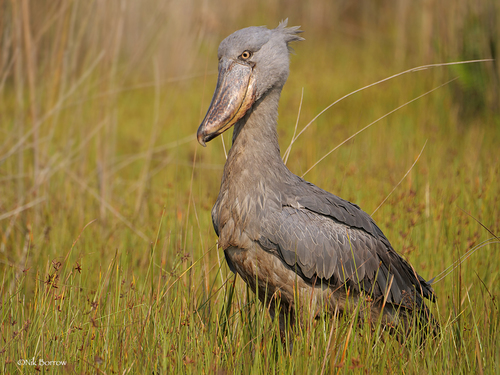
About Balaeniceps rex Gould, 1850
Basic Species Identification
Balaeniceps rex, commonly known as the shoebill, is a large tall bird.
Adult Height Range
Typical adult height ranges from 110 to 140 cm (43 to 55 in), and some individuals can grow as tall as 152 cm (60 in).
Body Length and Wingspan
Total length from tail to the tip of the beak is between 100 and 140 cm (39 to 55 in), and wingspan measures 230 to 260 cm (7 ft 7 in to 8 ft 6 in).
Body Weight and Sexual Dimorphism
Reported body weight ranges from 4 to 7 kg (8.8 to 15.4 lb); males average around 5.6 kg (12 lb), and are larger than the average female weight of 4.9 kg (11 lb).
Defining Bill Appearance
The species' defining feature is its very large, bulbous bill, which is pinkish with uneven grey markings.
Culmen Measurement
The exposed culmen, the measurement along the top of the upper mandible, ranges from 18.8 to 24 cm (7.4 to 9.4 in).
Bill Length Ranking
This makes the shoebill's bill the third-longest among living birds, behind only the bills of pelicans and large storks.
Bill Circumference
The circumference of the shoebill's bill, measured on the hard bony keratin portion, can be larger than that of pelicans.
Upper Mandible Structure
Like pelicans, the shoebill's upper mandible has a prominent keel that ends in a sharp curved tip.
Leg Characteristics
Shoebills have fairly long dark legs, with tarsal length measuring 21.7 to 25.5 cm (8.5 to 10.0 in).
Foot Adaptations
Their feet are exceptionally large; the middle toe is 16.8 to 18.5 cm (6.6 to 7.3 in) long, a trait that likely helps them stand on floating aquatic vegetation while hunting.
Neck Structure
Compared to other long-legged wading birds such as herons and cranes, the shoebill's neck is relatively shorter and thicker.
Wing Features
Its wings are broad, with a wing chord length of 58.8 to 78 cm (23.1 to 30.7 in), and are well suited for soaring flight.
Adult Plumage
Adult shoebills have blue-grey plumage, with darker slaty-grey flight feathers. The breast holds elongated feathers with dark shafts.
Juvenile Plumage
Juveniles have similar overall plumage color, but are a darker grey with a brown tint.
Chick Bill Development
Newly hatched shoebill chicks have a much smaller, initially silvery-grey bill. The bill grows noticeably larger by the time chicks are 23 days old, and is fully developed by 43 days of age.
Core Habitat Range
Shoebills live in freshwater swamps across central tropical Africa. Their range extends from southern Sudan and South Sudan through parts of eastern Democratic Republic of the Congo, Rwanda, Uganda, western Tanzania, and northern Zambia.
Key Population Strongholds
The species is most abundant in the West Nile subregion and South Sudan, particularly the Sudd, which is a key stronghold for the species. Sizeable populations are also found in wetlands of Uganda and western Tanzania.
Isolated Sightings
Isolated sightings have been recorded in Kenya, the Central African Republic, northern Cameroon, south-western Ethiopia, and Malawi.
Vagrant Records
Vagrant individuals have also been seen in the Okavango Basin in Botswana and the upper Congo River.
Habitat Overlap with Species
The shoebill's distribution largely overlaps with the ranges of papyrus and lungfish. They are most often found in flood plains that contain undisturbed papyrus and reedbeds.
Floating Vegetation Requirement
In areas with deep water, shoebills require a layer of floating vegetation to occupy.
Low Oxygen Water Preference
They are also found in water with low oxygen levels; low oxygen causes fish to surface for air more often, which increases the shoebill's chance of catching prey.
Movement Patterns
Shoebills are non-migratory, but they make limited seasonal movements in response to changes in habitat, food availability, and human disturbance.
Historical Range
Petroglyphs from Oued Djerat in eastern Algeria show that shoebills lived much further north during the Early Holocene, in the wetlands that covered what is now the Sahara.
Preferred Wetland Vegetation
Shoebills favor large, dense freshwater marshes. Almost all wetlands that the species uses have undisturbed Cyperus papyrus, along with reed beds of Phragmites and Typha.
Vegetation Preference Nuance
While the shoebill's distribution broadly matches the range of papyrus in central Africa, the species avoids pure papyrus swamps and prefers areas with mixed vegetation.
Unusual Foraging Habitats
Rarely, shoebills have been observed foraging in rice fields and flooded plantations.
General Behavior Traits
Shoebills are known for their slow movement and tendency to remain still for long stretches, leading to them being described as "statue-like".
Response to Human Disturbance
They are very sensitive to human disturbance, and may leave their nests if humans flush them from the area. However, when foraging, they can be quite tolerant of humans if dense vegetation separates them from people.
Solitary Foraging Behavior
Shoebills are solitary; even in areas with higher population density, individuals forage at least 20 m (66 ft) apart from one another.
Stalking Hunting Strategy
They stalk prey patiently, moving slowly and staying hidden while hunting. While hunting, shoebills move very slowly and often stay completely motionless.
Sight-Based Hunting
Unlike some other large wading birds, shoebills hunt entirely by sight and do not hunt using touch.
Prey Strike Mechanics
When prey is spotted, the shoebill strikes quickly and forcefully. Handling time after the strike can take more than 10 minutes depending on the size of the prey.
Strike Success Rate
Roughly 60% of strikes successfully catch prey. Strikes often snatch up water and vegetation along with prey, which is then spilled out from the edges of the mandibles.
Beneficial Hippo Activity
Hippopotamus activity can accidentally help shoebills, as submerged hippos sometimes force fish up to the surface.
Water Level Driven Movements
Depending on changes to surface water levels, shoebills may make small movements. Immature shoebills leave nesting sites when the surface water level rises, while adult shoebills leave nesting sites when the surface water level drops.
Nesting Site Preference
Both age groups are thought to prefer nesting sites with similar consistent surface water levels.
Floating Vegetation Perching
Unusually for such a large bird, shoebills often stand and perch on floating vegetation, similar to a giant jacana.
Sympatric Species Behavior
The similarly sized Goliath heron (Ardea goliath), which sometimes shares habitat with the shoebill, is also known to stand on aquatic vegetation.


