About Badamia exclamationis (Fabricius, 1775)
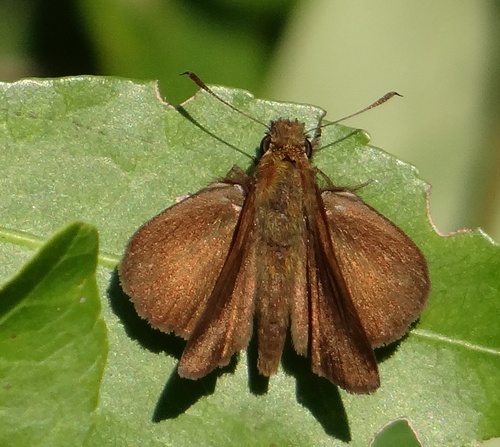
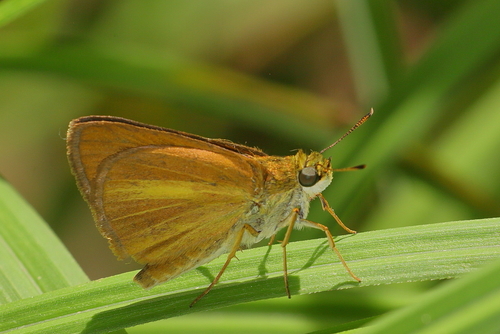
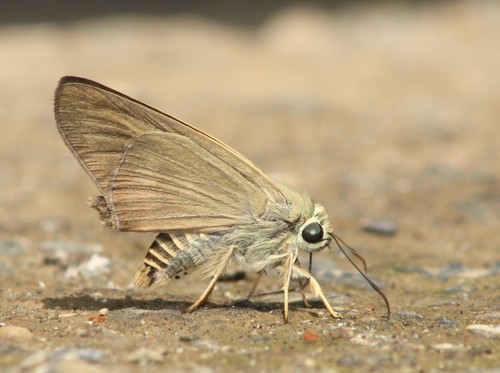
Badamia exclamationis, commonly called the brown awl, is a non-descript brown skipper butterfly, darker on the upper wing surface and lighter on the lower. Both sexes share the same appearance, aside from three to four semi-transparent forewing spots that cannot be used to distinguish sexes in field observation. This skipper has a light-brown abdomen marked with transverse black bands. The dry-season form is typically smaller, paler, and may lack these forewing spots. This species is easily identifiable by its long, narrow wings; among all Indian butterflies, it has the longest wings relative to their width. A detailed 1891 description by Edward Yerbury Watson is provided below. Genus characters: The forewing is narrow and elongated. Its costa is slightly arched at the base, and its exterior margin is very oblique, slightly convex below the apex. The cell is very long and narrow, reaching three-fourths of the wing length. The first subcostal branch originates at two-fifths, the second at one-fifth, the third at one-seventh, and the fourth originates close to the cell, with the fifth at the end of the cell. Disco-cellulars are very slender, inwardly oblique, nearly equal in length; the upper disco-cellular bends inward close to the subcostal. The upper radial starts from the angle, and the lower radial starts from their middle. Median branches are curved at their base; the middle branch originates about one-fourth before the end of the cell, and the lower branch originates three-fourths before the end of the cell. The submedian is curved in the middle. The hindwing is short, with a very convex apex, an angular lobe at the anal angle, and a short abdominal margin. The precostal projects inward; the costal vein curves upward from the base. The second subcostal originates one-third from the base. The cell is broad across its entire length. Disco-cellulars are very slender, scarcely visible, and equal in length. The radial starts from their angle and is very slender. The middle median originates about one-third from the base, and the lower median originates one-fifth from the base. The submedian is straight, and the internal is slightly curved. The thorax is stout; the abdomen is rather long and tapering; the head is broad; the palpi are broad and flattened at the front, with bristles on the outer edge, and the third joint is long, cylindrical, and projects forward. Fore-tibiae have a tuft of hairs beneath, and femora are slightly hairy beneath. Antennae have an elongated club and a long pointed tip. Species description: The upperside is dark purplish brown, with the base of both wings greyish olive brown. In males, the forewing has three transparent slender yellow spots arranged longitudinally on the upper disc, with the innermost spot ending within the cell. In females, the forewing spots are larger; the middle spot is oblique and irregularly angled, and an additional less distinct spot sits above the middle of the sub-median vein. The underside is pale greyish brown: the forewing has a darker brown discal area, the same spots as the upperside, and a pale ochreous posterior border; the hindwing has a dark brown anal area, bordered above by a short pale ochreous streak. The thorax is greyish olive brown; the abdomen is dark brown with pale ochreous bands on each segment; the front of the head and palpi is pale ochreous with brown streaks; the third joint of the palpi is brown; the legs are brown on the upper surface and pale on the lower surface. This species is distributed across Sri Lanka, India, Myanmar, Cambodia, South Yunnan, Australia and Japan. It is found throughout the Indian subcontinent and the Andaman Islands, and its type locality is South India.