About Backhousia subargentea (C.T.White) M.G.Harr.
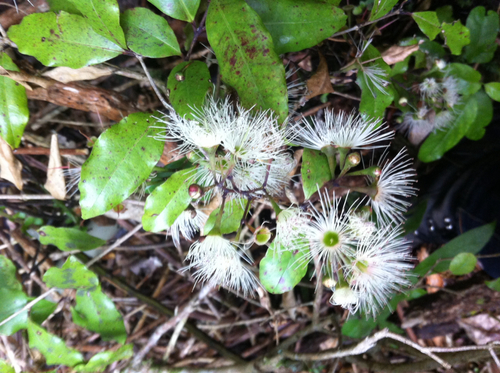
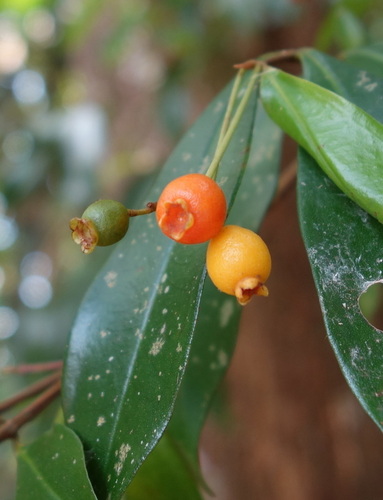
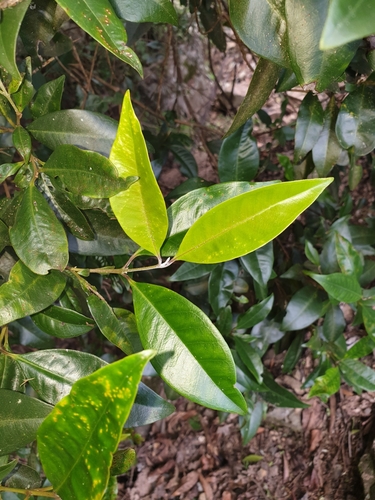
Backhousia subargentea is a small to medium tree that occasionally reaches 30 metres in height. It grows much smaller in New South Wales, only reaching 8 metres in height with a stem diameter of 20 cm. Its trunk is often multi-stemmed, crooked, not cylindrical in cross-section, and has some buttressing at the base. The trunk can be smooth and glossy, with an attractive orange-brown or pinkish mauve colour, or green where bark has recently shed. Sometimes the bark sheds irregularly, which creates a mottled trunk similar to spotted gum and leopardwood. The leaves are opposite, simple, and entire, and are either lanceolate or broad with a fine tip, around 4 to 8 cm long. The upper leaf surface is glossy dark green, while the lower surface is greyish fawn. Crushed leaves produce a familiar eucalyptus scent, as both this plant and eucalyptus are dry-fruited myrtles. Oil dots are visible when viewed with a magnifying glass. The midrib and lateral leaf veins are only visible on the upper leaf surface. An intramarginal vein surrounds the leaf, around 2 mm from the leaf edge. Leaf stalks are 5 to 10 mm long, with scaly material on the stalk. The white flowers are densely clustered in globular heads 5 to 8 mm long, and emerge in April. The fruit matures approximately six months later, forming a small dry capsule 5 mm in diameter that grows on a stalk 6 to 10 mm long. If this species were not so rare, it could potentially be used as an ornamental tree.