About Babiana villosa (Aiton) Ker Gawl.
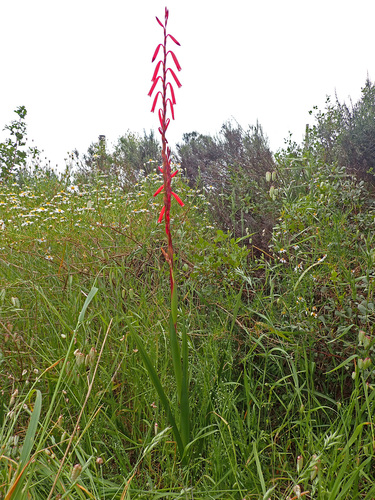
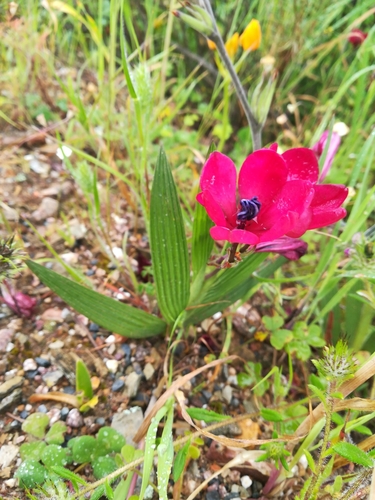
Babiana villosa (Aiton) Ker Gawl. is a perennial geophyte that reaches 10–20 cm (3.9–7.9 in) in height, emerging from an underground globular corm at the start of its growing season. Its stem is covered in velvety hairs and is mostly strongly deflexed. The leaf blades are hairy, lance-shaped, laterally compressed to create distinct right and left surfaces instead of upper and lower surfaces, and pleated, meaning the leaf surface abruptly and repeatedly changes angle at each vein. Each individual flower is subtended by two green bracts with dry brown tips; these bracts are 13–24 mm (0.51–0.94 in) long, and may exceptionally reach up to 28 mm (1.1 in) long. The inner bract is only half to two-thirds as long as the outer bract, and is split into two halves along its full length. The inflorescence is an ascending spike holding three to eight unscented flowers. The radially symmetrical star-shaped perianth is mauve-pink, purple, or scarlet, and consists of a slender tube 16–28 mm (0.63–1.10 in) long, rarely up to 36 mm (1.4 in) long, that abruptly divides into six nearly identical spoon-shaped oval tepals. These tepals are 28–33 mm (1.1–1.3 in) long and 12–15 mm (0.47–0.59 in) wide, and stay partially cupped even when fully open. Unlike the arrangement seen in almost all other Babiana species, the stamens of B. villosa are regularly distributed around the style. The stamens have upright filaments 8–15 mm (0.31–0.59 in) long, topped by arrow-shaped blackish to dark purple anthers that are 7–9 mm (0.28–0.35 in) long and 3 mm (0.12 in) at their widest point. The anthers release pollen through a sideways (latrorse) split. The hairless ovary supports a style that divides just below or at the level of the bottom of the anthers into three 2–3 mm (0.079–0.118 in) long branches. The ovary develops into a dry capsule that splits lengthwise to release many irregularly angled dark brown seeds. This species, locally called rooibobbejaantjie, flowers during August and September. B. villosa occurs between Malmesbury and Wellington in the Western Cape province of South Africa. It grows on lower mountain slopes, hills, and flats in fertile, stony clay within Breede Shale Renosterveld vegetation, often growing alongside blue-flowered forms of Lachenalia unifolia, the pink orchid Satyrium erectum, and red-flowered Geissorhiza erosa. The corms are hard to collect because they typically wedge between stones in heavy clay soils that become extremely hard during summer, which also protects them from foraging baboons, porcupines, and mole rats. Corms begin growing in autumn, continue growing through winter, and flower in spring. The species remains locally common in remaining patches of renosterveld, particularly in the Tulbagh Valley. Around Malmesbury, it is pollinated by the monkey beetles Anisonyx ursus and A. ditus, while in the Tulbagh Valley it is pollinated by Peritrichia rufotibialis and Lepithrix ornatella. It has a range of almost 2,000 km² (770 mi²) and is known from sixteen locations. As a short-lived species, it has lost approximately 80% of its former habitat to agricultural development, especially olive cultivation and vineyards. Habitat loss is ongoing, so B. villosa is classified as a near-threatened species. Specialist bulb growers cultivate B. villosa for use in rock gardens or as a container plant.