About Babiana sambucina (Jacq.) Ker Gawl.
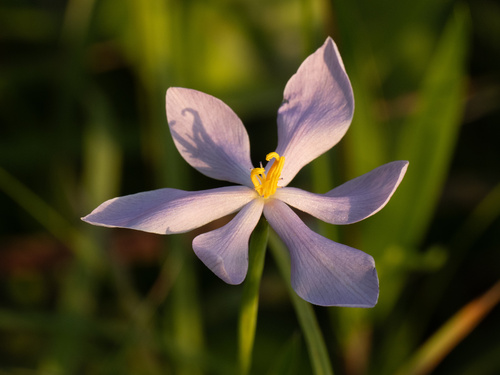
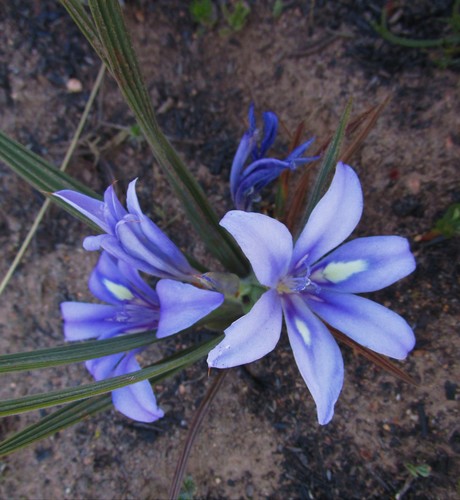
Babiana sambucina (Jacq.) Ker Gawl. is a perennial geophyte that grows from a globose corm covered in a fibrous outer layer, reaching a height of 8–30 cm (3.1–11.8 in). Each growing season, it produces up to six leaf blades that are lance-shaped to linear, variably pleated, and variably hairy, with at least a silky texture at their base. Leaf blades are angled relative to their petioles, and grow taller than the plant's inflorescence. Each flower of Babiana sambucina is subtended by two bracts. The outer bract measures 25–40 mm (0.98–1.57 in) long, is slightly larger than the inner bract, and clasps the inner bract. Both bracts are green with rust-brown tips; the inner bracts are only forked at their tips. Sometimes both bracts are fused at their base, surrounding the ovary. The lowest outer bract is enlarged, and can grow up to 6 cm (2.4 in) long. Flowers are clustered in dense spikes, with few to several flowers per spike. Most flowers are strongly violet-scented, though some individuals produce scentless flowers. The mirror-symmetrical perianth is made up of six tepals that are fused into a narrow 35–60 mm (1.4–2.4 in) long tube, becoming funnel-shaped further upward and free near the top. Free tepal lobes are 20–35 mm (0.79–1.38 in) long and 5–12 mm (0.20–0.47 in) wide, and often remain overlapping even when the flower is fully open. The perianth does not form two distinct lips, and is blue to violet in color. The lower lateral tepals have a white marking at their center, which is outlined by a distinct or faint blue to carmine line, and sometimes have a patch of carmine color running down the center of the marking. The three lower tepals may be fused up to 2 mm higher than the upper tepals. Three stamens are clustered on the dorsal side of the flower, with approximately straight filaments 10–20 mm (0.39–0.79 in) long, topped by 7–10 mm (0.28–0.39 in) whitish anthers. The ovary is hairless; in the lowest flower of the inflorescence, it may sit on a short stalk. The style divides into three branches positioned opposite the lower two-thirds of the anthers. Babiana sambucina grows in dry fynbos and renosterveld, in soils formed from eroded sandstone, on stony outcrops, slopes, and flats. B. sambucina subsp. sambucina is widespread across the interior of South Africa's Western and Eastern Cape provinces, ranging from the Kouebokkeveld Mountains in the west to Addo and Uitenhage in the east. This subspecies is known to be pollinated by long-tongued bees, mostly larger species of the genus Anthophora, and its conservation status is least concern. B. sambucina subsp. longibracteata is pollinated by long-tongued flies. It is currently only known from five locations. While it was recorded from more locations before 1970, its native range has been rapidly converted for rooibos cultivation over the past decade. Its habitat will continue to be lost, so it is expected to decline further, and as a result it is classified as endangered.