About Babiana rubrocyanea (Jacq.) Ker Gawl.
Babiana rubrocyanea, commonly called Rooibloubobbejaantjie, is a perennial geophyte that reaches 5–15 cm (2.0–5.9 in) in height. It emerges above ground to grow leaves and flowers during winter and spring, and dies back above ground in anticipation of the hot, dry summer, surviving underground via its corm. This corm is covered in a multi-layered fibrous tunic. A strongly outward-flexed, circular cross-section, hairy branching stem grows from the top of the corm, and a fibrous collar surrounds the base of the stem.
Each leaf is made of a narrow sheath that partially encloses the sheaths of other leaves and the stem, paired with a laterally compressed blade that has right and left surfaces rather than upper and lower surfaces. The axils of the sheath and blade meet at a distinct angle. Leaf blades are pleated, lance-shaped, and hairy. The inflorescence holds multiple flowers, and each flower is enclosed at its base by two bracts. These bracts measure 18–30 mm (0.71–1.18 in) long, are velvety, and are green with brown tips. The inner bract is slightly shorter than the outer bract, and is split along its center all the way to the base.
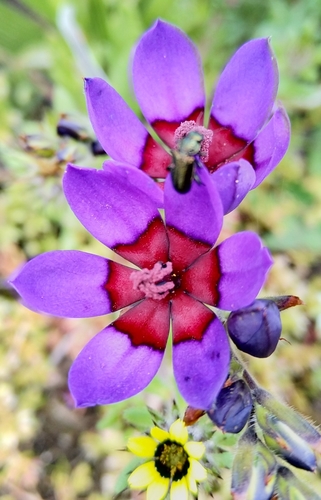
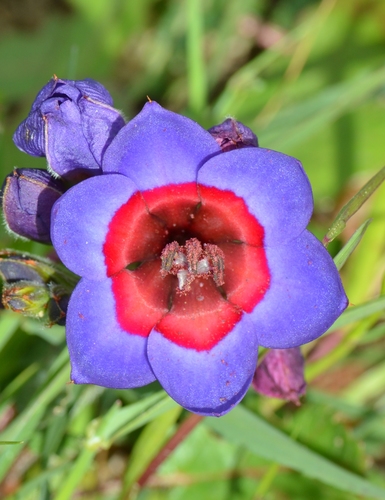
The flowers of B. rubrocyanea have an almost radially symmetrical dark blue perianth, which is paler around a carmine-colored central region. The perianth is made of 6 tepals that are fused at the base to form a narrowly funnel-shaped tube 15–20 mm (0.59–0.79 in) long, and are free at the top, where 20–24 mm (0.79–0.94 in) long lobes form a wide cup. The three stamens have 10–13 mm (0.39–0.51 in) long filaments that are clustered opposite the stem and curve over the lower tepal lobe. They are topped by 6–7 mm (0.24–0.28 in) long reddish brown anthers. This arrangement shows that the flowers are rotated 180 degrees, a rare trait that only occurs in three other species of Babiana. The ovary sits at the center of the flower at the base, it is hairy above its base, and is topped by a style that branches at the midlength of the anthers into three short arms with broad, flattened tips.
Rooibloubobbejaantjie is only found on renosterveld in the coastal area of South Africa's Western Cape province, near Darling. Flower visitors that have been observed include monkey beetles and the horsefly Philoliche atricornis. It grows in Swartland Alluvium Renosterveld and Swartland Granite Renosterveld, in shallow alluvial sand over clay that is damp during winter. More than 80% of this species' natural habitat has been lost to agricultural development, leaving only a few small, isolated patches. Ongoing urban expansion around Darling is an additional threat, alongside competition from invasive alien grasses and heavy grazing. Finally, existing renosterveld fragments are rarely burnt, and regular burning is required to maintain healthy populations of this species. For these reasons, B. rubrocyanea is classified as an endangered species.