About Babiana nana (Andrews) Spreng.
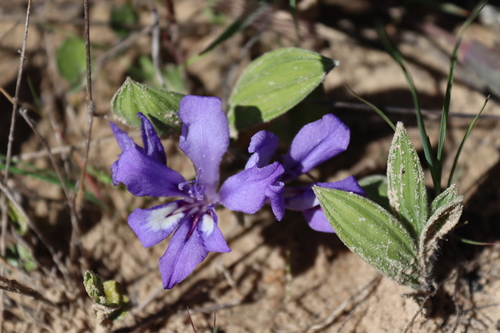
Babiana nana (Andrews) Spreng. is a geophytic perennial plant that reaches 6–15 cm (2.4–5.9 in) in height. Most of its stem grows underground, and the stem may be branched. Unlike some related species, it lacks a fibrous collar around the stem at the soil surface, though the stem does emerge above ground. Each leaf consists of a sheath that encloses the sheaths of higher-positioned leaves, and a blade that grows almost upright or at an angle to the sheath. The leaf blade is densely covered in soft hairs, and is laterally compressed, meaning it has distinct right and left sides rather than upper and lower sides. Its surface is not flat, but is slightly to moderately pleated, with abrupt, repeated changes in leaf angle at each vein. Leaf blade shape varies by subspecies: it is oval to narrowly lance-shaped in B. nana subsp. nana, and narrowly lance-shaped to almost linear in B. nana subsp. maculata. Leaf blades are not coiled, their margins do not undulate, and their tips range from pointy to blunt, but never end in multiple irregular teeth. The inflorescence is upright or somewhat inclined, and holds two to six mirror-symmetrical flowers. Each flower is subtended by two fully green, densely hairy bracts that measure 16–30 mm (0.63–1.18 in) long; the outer bract is slightly longer than the inner one. The inner bract is only forked at its tip, which differs from many other Babiana species that have inner bracts split more deeply, or all the way to the base. The flowers have an oblique funnel-shaped perianth tube 12–17 mm (0.47–0.67 in) long, which divides into six tepals. The upper three tepals are slightly larger than the lower three, measuring 25–30 mm (0.98–1.18 in) long, while the lower three are joined over a short distance and measure 22–25 mm (0.87–0.98 in) long. The perianth is violet to blue, or rarely pale pink, and the lower lateral tepals have white or cream-coloured markings. Flowers usually carry a strong rose-violet scent. Three filaments cluster alongside the dorsal tepal, measuring 10–14 mm (0.39–0.55 in) long, and are topped by anthers 5–6.5 mm (0.20–0.26 in) long. The inferior ovary is smooth, or sometimes only has short hairs along its ribs. The style splits into three branches that usually sit opposite the anther tips or slightly higher; the branches are 3–5 mm (0.12–0.20 in) long. Flowering occurs from late August to late September. Babiana nana subsp. nana is found along the west coast of South Africa's Western Cape province. Historically, it occurred from Saldanha on the Vredenburg Peninsula in the north to Milnerton in the south, but it is now extinct in the southern part of its former range. It grows on sandy plains and dunes, in the following vegetation types: Atlantis Sand Fynbos, Cape Flats Dune Strandveld, Cape Flats Sand Fynbos, Hopefield Sand Fynbos, Langebaan Dune Strandveld, Saldanha Flats Strandveld, Saldanha Granite Strandveld, and Swartland Granite Renosterveld. This subspecies is classified as endangered, because its populations are severely fragmented and declining, primarily due to alien plant invasion and coastal development. Its remaining range covers at most 1,400 km2 (540 mi2). Babiana nana subsp. maculata occurs along the south coast of the Western Cape province, from the Cape Peninsula in the west to Mossel Bay in the east. It grows in dunes and on sandy coastal flats. This subspecies is classified as near-threatened, because its current range is severely fragmented and its habitat is being lost extensively to competition from alien plants, conversion to agricultural land, and coastal urban development. However, its range is much larger than that of subsp. nana, covering 36,000 km2 (14,000 mi2).