About Babiana mucronata (Jacq.) Ker Gawl.
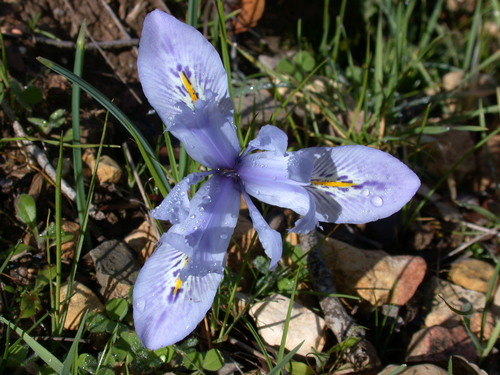
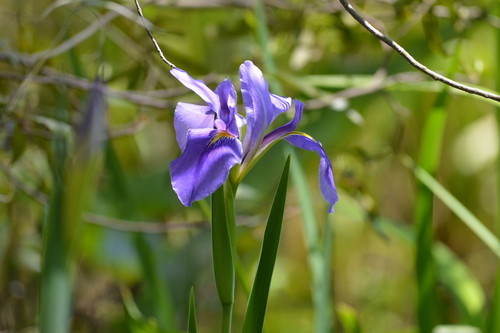
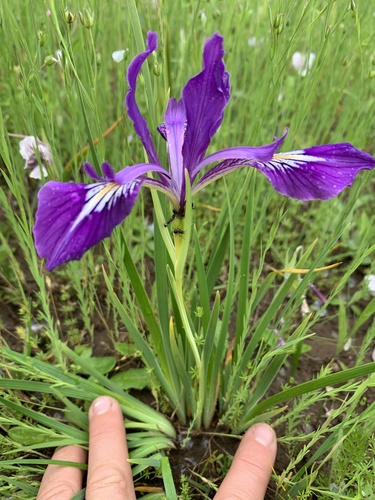
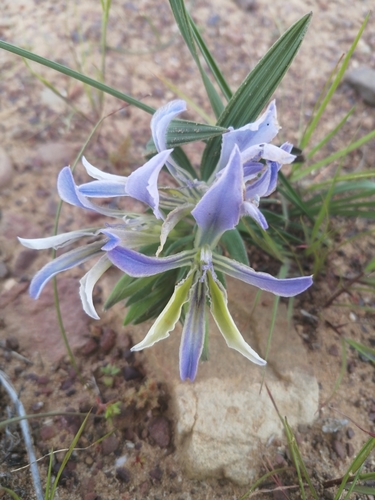
Babiana mucronata is a perennial plant that grows 5–18 cm (2.0–7.1 in) tall. Each year, it produces new leaves and flowers from an underground corm that can reach up to 2.5 cm (0.98 in) in diameter. Its leaves range from linear to sickle-shaped, are slightly pleated, and may be thinly hairy or hairless, measuring 7–20 mm (0.28–0.79 in) wide. It bears a simple or branched inflorescence that is a more or less upright or outward-bending spike, with at least 3, and usually 6 to 12, mirror-symmetrical flowers. Flower color ranges from dark to pale violet-blue, and scents may be acrid, metallic, or absent in some flowers. A thick fibrous collar surrounds the underground portion of the stem. Each flower is subtended by two bracts that are green overall, except for their dry russet-colored tips. The outer bract has a squared-off, blunt tip, or may have three teeth. The inner bract is only half as long as the outer bract, or slightly shorter, and is split all the way to its base. The perianth is fused below into a narrowly funnel-shaped tube that is 10–25 mm (0.39–0.98 in) long, and splits into six unequal tepals near the top. The dorsal tepal forms the upper lip and measures 25–35 mm (0.98–1.38 in) long. The remaining tepals together form the lower lip; they are fused for an additional 3–5 mm (0.12–0.20 in), and the lower tepals are 15–18 mm (0.59–0.71 in) long. These lower tepals are marked with white to pale yellow blotches that are outlined by a darker violet-blue edge. Three stamens are clustered close to the upper lip; each stamen has a curved filament 13–16 mm (0.51–0.63 in) long that holds a pale violet or turquoise anther 5–7 mm (0.20–0.28 in) long. Below the perianth is a densely hairy ovary that supports a style, which splits into three 3–4 mm (0.12–0.16 in) long branches opposite the middle half of the anthers. Flowering occurs between late July and September. This species, also known as Olifantsbobbejaantjie, occurs in the Western Cape province of South Africa, ranging between Tulbagh and Piketberg in the south, and Pakhuis Pass and the Olifants River Mountains in the north. Within this range, it grows on rocky outcrops, stony clay, and sandstone rubble on slopes and flats. The nominate subspecies, Babiana mucronata subsp. mucronata, is classified as least concern for conservation status. Babiana mucronata subsp. minor grows in sandy soils within the Nardouw Sandstone Fynbos and Bokkeveld Sandstone Fynbos vegetation types, on Gifberg, its slopes, and the Bokkeveld Mountains. This subspecies is only known from five locations, which are threatened by agricultural development for rooibos cultivation, so it is classified as endangered.