About Babiana hirsuta (Lam.) Goldblatt & J.C.Manning
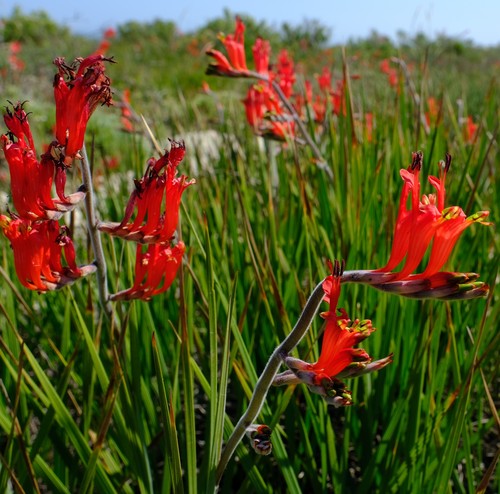
Babiana hirsuta is a 40–70 cm (16–28 in) tall perennial plant that grows from an underground globular corm at the start of its growing season. It produces an upright, densely hairy flowering stem with short, horizontal branches. Each of its leaves is made up of a sheath and a blade that sit at an angle to one another. The leaf sheath tightly wraps around the sheaths of leaves growing higher on the shoot, while the leaf blade is lance-shaped, stiff, covered in short or bristly hairs, and laterally compressed. This compression creates left and right leaf surfaces instead of upper and lower surfaces. The blades are pleated, meaning the leaf surface changes angle abruptly and repeatedly at each vein, and the leaves are arranged in a fan shape. Every individual flower is subtended by two bracts. The outer bract measures 18–30 mm (0.71–1.18 in) long, is larger than the inner bract, and clasps it. Both bracts are either hairless or covered in short hairs, are green with dry brown tips. The inner bract has two prominent veins, is transparent along its center, and is forked to about its midlength. The many mirror-symmetrical flowers are scentless, upright, face outward, and are crowded on several ascending branches. Each flower has a fused, narrowly funnel-shaped perianth tube at its base that is 30–40 mm (1.2–1.6 in) long, plus six separate tepal lobes divided into an upper lip made of three dorsal tepals and a lower lip made of the remaining three lower tepals. Most of the flower is bright scarlet, but the lower tepals have a yellow blotch marked with dark green near the blotch's base. The dorsal tepal is 16–20 mm (0.63–0.79 in) long, upright, and has inward-curled edges that enclose parts of the filaments of the three stamens; it fuses with the lateral dorsal tepals around 6 mm (0.24 in) higher than the upper edge of the lower lateral tepals. The upper and lower tepals are each around 8 mm (0.31 in) long. The stamens have straight filaments 37–40 mm (1.5–1.6 in) long that extend beyond the tip of the dorsal tepal. The inferior ovary is hairless and supports a style that splits into three branches opposite the lower half of the anthers; these branches are around 4 mm (0.16 in) long. Flowering takes place between July and October. Locally called Strandlelie, Babiana hirsuta occurs along the coast of Namaqualand, from the mouth of the Orange River in the north to Saldanha Bay in the south. It is likely that the species also grows in part of the Sperrgebiet in southwestern Namibia, but this area is closed to plant exploration to prevent illegal diamond mining. The wide perianth of the flower holds up to 30 μl of nectar, and the species is pollinated by both dusky sunbirds and malachite sunbirds. It grows on sandy flats and dunes in desert and Succulent Karoo habitats. Across its 21,000 km² (8,100 mi²) distribution range, the species is known from seventeen locations. It is threatened by diamond mining in the northern part of its range, while southern populations face pressure from overgrazing and coastal development. There are also plans to mine heavy minerals near the Groenrivier. Because of these threats, Babiana hirsuta is classified as a near-threatened species.