About Babiana bainesii Baker
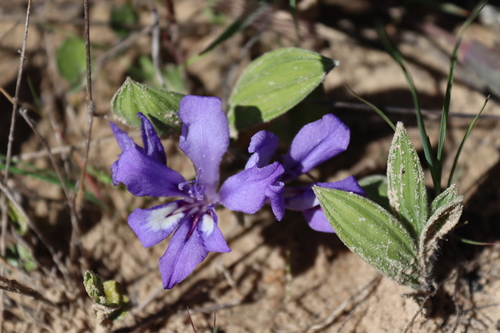
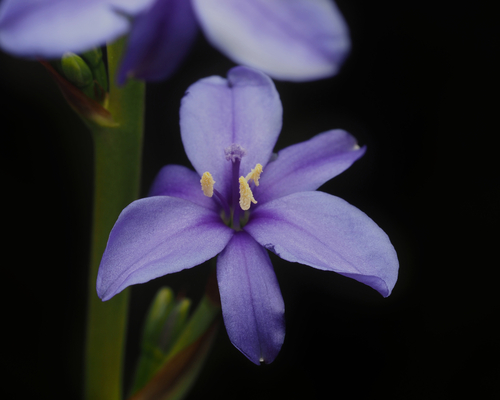
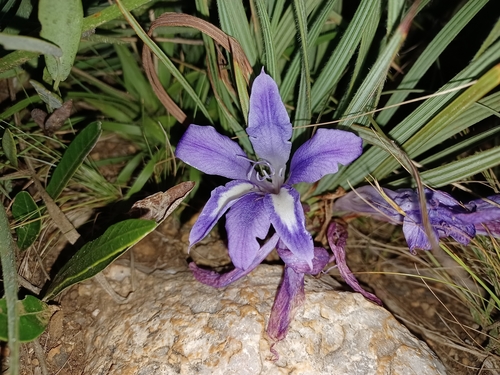
Babiana bainesii is a hairless, geophytic perennial plant that reaches 15–25 cm (5.9–9.8 in) in height. Its stem grows underground, so flowers emerge individually at ground level. Leaf blades grow directly from the ground, reaching much higher than the flowers. The leaves are linear to sword-shaped, 15–25 cm (5.9–9.8 in) high, 3–10 mm (0.12–0.39 in) wide, and can be densely hairy, bristly, or nearly hairless. Leaves are pleated, meaning their surface changes angle abruptly and repeatedly at each vein. The leaf blade outline is sword-shaped to narrowly lanceolate, 2.5–4 mm (0.098–0.157 in) wide. Leaf blades are not coiled, with sharp pointed tips that do not end in multiple irregular teeth. Each flower is subtended by two bracts 35–60 mm (1.4–2.4 in) long, with a papery or membranous texture. The bracts are russet-coloured across their entire surface or only at the tips; the outer bract is slightly longer than the inner bract. Unlike the inner bracts of many related Babiana species, which are deeply forked or split all the way to the base, the inner bract of Babiana bainesii is only forked at the tip. The inflorescence holds two to eight mirror-symmetrical blue, violet, or mauve flowers that develop below ground level. The lower lateral tepals have contrasting white blotches against their main color. Three stamens are clustered under the dorsal tepal. Flowering occurs between February and May, and flowers are often sweetly scented. The base of each flower forms a narrowly funnel-shaped tube 40–55 mm (1.6–2.2 in) long, exceptionally up to 70 mm (2.8 in), which divides into six unequal tepals. The dorsal tepal is 4–5 cm (1.6–2.0 in) long. The upper lateral tepals remain fused with the lower lateral tepals about 6 mm (0.24 in) further than they are fused with the dorsal tepal; these tepals are 2.5–4 cm (0.98–1.57 in) long and together form a lower lip. The three stamens are clustered close to the dorsal tepal, and consist of 10–15 mm (0.39–0.59 in) long filaments topped by anthers that are 8–10 mm (0.31–0.39 in) long, occasionally up to 12 mm (0.47 in) long, and white or cream-coloured. The ovary is hairless and sits on a very short stalk in lower flowers. It bears a style that splits into three branches opposite the anther tips; these branches are about 6 mm (0.24 in) long. Babiana bainesii has a large distribution across summer rainfall areas of southern Africa, ranging from the Great Karoo on the border of South Africa’s Western Cape and Northern Cape provinces, through North West, Gauteng, Mpumalanga, and Limpopo, extending into Botswana, Zimbabwe, southernmost Zambia, and Namibia. It grows in bushland and dry grassland on sandy and stony flats and slopes, and it is classified as a least concern species.