About Azanus ubaldus (Cramer, 1782)
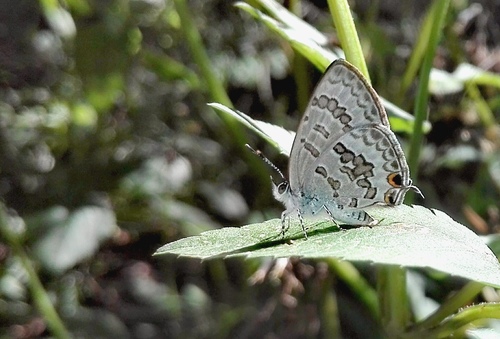
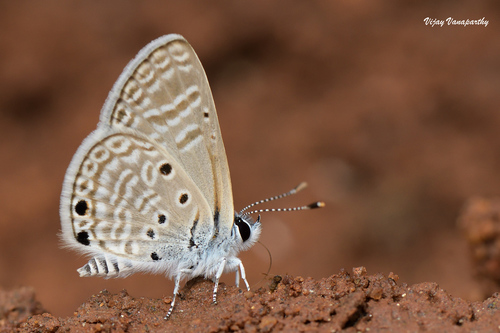
This description covers Azanus ubaldus (Cramer, 1782), with separate details for males and females. For males: the upperside is brownish purple, with dark blue coloring at the base of the wings. On the forewing, the costa is very narrow along its apical half, and the termen is evenly edged with brown, with the edge growing a little broader from the apex to the tornus. The area on the disc, within the cell and beyond it, is covered with hair-like specialized scales and is distinctly darker. On the hindwing, coloration is similar to the forewing, but the brown edging of the costa is much broader. Posteriorly in the tornal area, there is a dark spot in interspace 1 and another more clearly defined similar spot in interspace 2; both spots merge more or less into the terminal brown edging. The cilia of both the forewings and hindwings are white, with their basal halves evenly dark brown. The underside is greyish brown. On the forewing, there are two short white lines, one on each side of the discocellulars; a minute black subcostal dot sits above the apex of the cell, and another similar dot lies a little beyond it. Two parallel, obliquely placed, transverse upper discal white lines follow these dots, and are in turn followed by an inner and an outer obliquely placed, irregular, broken subterminal line that is also white. The inner subterminal line is somewhat lunular, and an anteciliary dark line is present. The posterior third of the wing from the base is uniform and somewhat paler than the rest of the wing. On the hindwing, the following conspicuous black spots encircled with white are present: 4 subbasal spots arranged in transverse order, a subcostal spot in the middle of interspace 7, two minute paired (geminate) spots at the tornal angle, and a larger spot in interspace 2. Two short transverse white lines lie on either side of the discocellulars, matching the pattern on the forewing. A transverse, curved, catenulated discal band of white markings follows these lines, and is succeeded by a postdiscal and subterminal series of white lunules and an anteciliary dark line that is edged inwardly with white. The antennae are dark brown, with shafts ringed with white; the apex of the club is also white. The head, thorax, and abdomen are dark brown; fresh specimens have a small amount of purplish-blue pubescence on the thorax. On the underside, the palpi, thorax, and abdomen are white. For females: the upperside is rich silky brown. Both the forewings and hindwings are suffused with purplish blue at the base, and have anteciliary black lines. The hindwing has two black spots in the tornal area matching those seen in males. The underside matches that of the male, but markings are more regular, more evenly and neatly defined, and the white transverse lines on the forewing extend to the dorsal margin. The cilia, antennae, head, thorax, and abdomen are similar to those of the male, but the female thorax lacks bluish pubescence (fine hairs) on the upperside. Individual specimens of Azanus ubaldus show notable coloration variation when compared to specimens from other regions of South Africa, such as Witsand.