About Aythya ferina (Linnaeus, 1758)
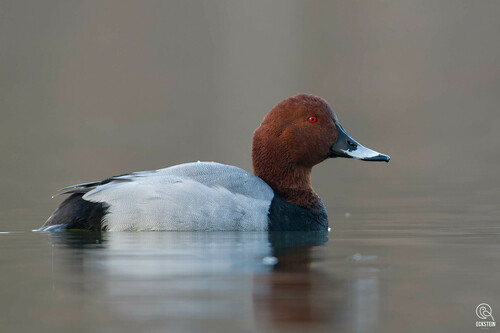
The common pochard (Aythya ferina (Linnaeus, 1758)) is a plump, medium-sized diving duck. Adults measure 42–49 cm (17–19 in) in length, with a wingspan of 72–82 cm (28–32 in). This species is stocky and short-tailed, with a sloping forehead and a relatively long bill. Reported weight, measured only for winter birds, ranges from 467 to 1,240 g (16.5 to 43.7 oz). On average, males are larger and heavier than females. Like most duck species, the common pochard is sexually dimorphic. Males have a chestnut-coloured head and neck, a black breast and tail, and a pale grey body marked with fine vermiculations. Males have a dark grey bill with a wide blue-grey band across the middle; their irises range from yellow-orange to red, and grow brighter during the breeding season. Legs and feet are grey in both sexes and all age groups. Females have brown irises, which sometimes tend toward yellowish-brown. Juveniles have yellow-olive irises, which develop into the adult colour during the bird's first winter. Their breeding habitat is marshes and lakes with water depth of one metre or more. Common pochards breed across much of temperate and northern Europe and throughout the Palearctic. They are migratory, and spend the winter in southern and western Europe. In the British Isles, breeding populations are found in eastern England and lowland Scotland, with small, gradually increasing numbers in Northern Ireland, and sporadic (potentially increasing) occurrence in the Republic of Ireland. While uncommon, individual common pochards are occasionally seen in southern England, and small populations are sometimes observed on the River Thames. Large numbers of common pochards from Russia and Scandinavia overwinter in Great Britain. This species has been recorded as a vagrant in North America, especially in the United States and Canada, and a single record exists for South America in Colombia. Common pochards are gregarious birds. They form large flocks in winter, often mixing with other species of diving duck. They are strong fliers, and can reach speeds of 22–24 m/s (49–54 mph) during direct flapping flight. Common pochards eat plant material including seeds, small fish, molluscs, and other aquatic invertebrates. They feed primarily by diving to retrieve food from under the water's surface, but will also upend and dabble for items on the water's surface. Most feeding activity occurs at night. They regularly forage in close association with Bewick's swans and whooper swans, which trample underwater sediment to excavate their own food. Studies show this behaviour greatly increases the common pochard's food intake rate, as the pochards glean food items that drift away from the trampled area. Their feeding rate can be double the rate when they forage alone.