About Aythya baeri (Radde, 1863)
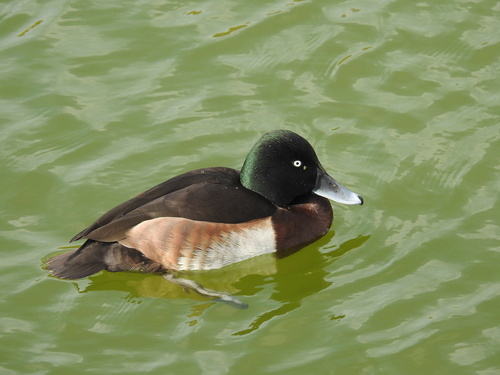
The Baer's pochard (Aythya baeri) measures 41–47 cm (16–19 in) in length, with a 70–79 cm (28–31 in) wingspan. Males are slightly larger on average, weighing 500–730 g (18–26 oz), with wing length 18.6–20.3 cm (7.3–8.0 in), tail length 53–60 mm (2.1–2.4 in), and culmen length 38–44 mm (1.5–1.7 in). Females average 590–655 g (20.8–23.1 oz) in weight, with wing length 19.1–20.5 cm (7.5–8.1 in), tail length 51–64 mm (2.0–2.5 in), and culmen length 40–44 mm (1.6–1.7 in). For both sexes, tarsometatarsus length ranges from 33–34.7 mm (1.30–1.37 in). Breeding males have a black head and neck with green gloss, white or pale yellow eyes, a blackish-brown back, dark chestnut breast, and white or light chestnut flanks, paired with a short, low tail. In poor light, breeding males can appear entirely black. Females have brown eyes and a dark brown head and neck that blends into chestnut-brown breast and flanks. Eclipse and first-winter males resemble females, but keep the characteristic white eyes of breeding males. Both sexes have wide white speculum feathers, a white vent-side, a dark-grey bill, a black bill nail, and dark-grey tarsometatarsus. Baer's pochard is closely related to the ferruginous duck (A. nyroca), and both share a white vent-side, male iris, black bill nail, and wide white speculum feathers. Baer's pochard is larger than the ferruginous duck, with a longer head, body, and bill. Unlike the ferruginous duck's tall, triangular head, Baer's pochard has a more rounded head and flatter forehead. The white portion of the Baer's pochard's belly extends to its flanks, visible when the bird floats on water, while the ferruginous duck has a much smaller white belly patch. Female Baer's pochard also have a distinct bright chestnut spot at the lore, which is not present in ferruginous ducks. Baer's pochard is typically a quiet species. During courtship displays, both sexes produce a harsh graaaak call. Outside of courtship, females may make a kura kura kura call, while males may produce a kuro kuro call. Baer's pochard traditionally bred in the Amur and Ussuri basins of Northeast China and the southeastern Russian Far East. In recent years, it has also colonized North China and Central China. It winters across most areas south of the Yellow River in China, as well as in Taiwan, Japan, Bangladesh, India, North Korea, Laos, Myanmar, Nepal, Thailand, and Vietnam; it occurs as a rare vagrant in Bhutan, South Korea, the Philippines, and Pakistan. The species departs its wintering grounds by mid-March, and returns to them by mid-October or early November. Baer's pochard has become extremely rare in its traditional breeding areas, and there have been no confirmed breeding reports at any sites north of Beijing since 2010. The total number of individuals recorded during the breeding season is smaller than the number recorded in winter, so unknown breeding sites may still exist. For example, there are unconfirmed doubtful breeding reports from the Chinese portion of Lake Khanka, the Russian portion of Lake Khasan, and Muraviovka Park. Since 2012, new breeding sites have been discovered in multiple Chinese provinces including Hebei, Hubei, and Jiangxi; Hubei and Jiangxi are located far from the species' traditional breeding grounds in the Amur and Ussuri basins. Warmer climate in these new breeding areas provides a longer breeding season (roughly twice as long as the season in the Amur and Ussuri basins), which allows birds to lay a replacement clutch if their first clutch fails. Baer's pochard is no longer migratory in central and eastern China. Wintering grounds have also contracted significantly in recent years. Since at least the winter of 2010-2011, Baer's pochard no longer winters at any sites outside mainland China, except when appearing as a vagrant. Within mainland China's wintering grounds, the population has also declined severely by more than 99%. Baer's pochard is a shy species that inhabits open, slow-flowing lakes, swamps, and ponds. It breeds around lakes with abundant aquatic vegetation, nesting in dense grass, flooded tussock meadows, or flooded shrubby meadows. During winter, it forms large flocks with other pochards on large, open freshwater lakes and reservoirs. It has strong wings, and can fly and walk at high speeds. It is also an excellent diver and swimmer, and can take off quickly from the water when threatened or disturbed. During migration season, they form small groups of more than 10 or dozens of birds, flying at low altitudes in wedge-shaped formations. In winter, Baer's pochard sleeps during the day, leaves for unrecorded feeding sites alongside other ducks at dusk, and returns before dawn. Beyond aquatic plants, grass seeds, and molluscs, little is known about this species' diet.