About Axyris amaranthoides L.
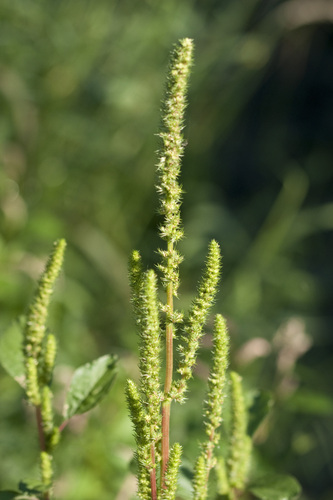
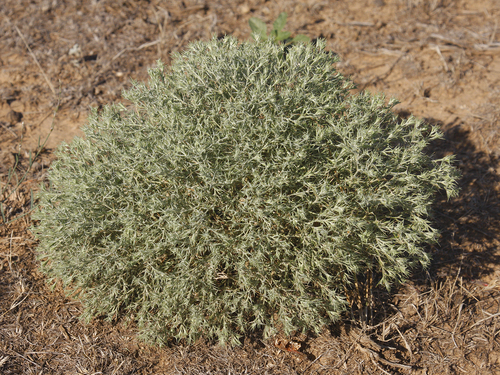
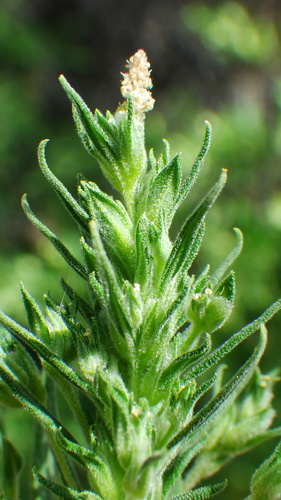
Axyris amaranthoides is an annual monoecious plant, meaning each individual produces both male and female flowers. It has a taproot root system, with rigidly upright stems that reach 20–80 centimetres (8–31 inches) in height. Lower leaves have short petioles and range from narrowly oval to long-pointed in shape. Upper leaves are shaped from narrowly lance-like to egg-shaped, and attach directly to stems or branches without petioles. Leaves growing on the main stem are much larger than leaves growing on branches; all leaves have serrated margins with edges that are slightly bent, curved backward, or curved downward. Leaves are arranged alternately along the stem: one leaf grows at each node, forming an ascending spiral pattern, a type of arrangement known as alternate phyllotaxis. Male flowers grow as a slim spike at the top of the stem. One or two female flowers grow from the leaf axils located below the male flowers. The fruits of Axyris amaranthoides are oval, reddish, and dry, with thin pericarps. Some fruits are winged on one side, flattened, and germinate rapidly. Other fruits are wingless and typically remain dormant. This species flowers during July and August. In general, A. amaranthoides grows well on very fine-grained mineral soil, and on soils composed of waste or rough fragments of stone, brick, and concrete. It is most often found in dry roadsides, waste places, and open flat habitats such as grassland. Axyris amaranthoides is originally native to Russia or Siberia, according to 1978 records from Scoggan, and is naturalized in North America. It is distributed across Canada and the northern United States, and has spread through multiple Canadian provinces: British Columbia, New Brunswick, Prince Edward Island, Nova Scotia, Québec, Saskatchewan, and Ontario. It can also be found in some regions of Asia and Europe outside of its native range.