About Avicennia marina (Forssk.) Vierh.
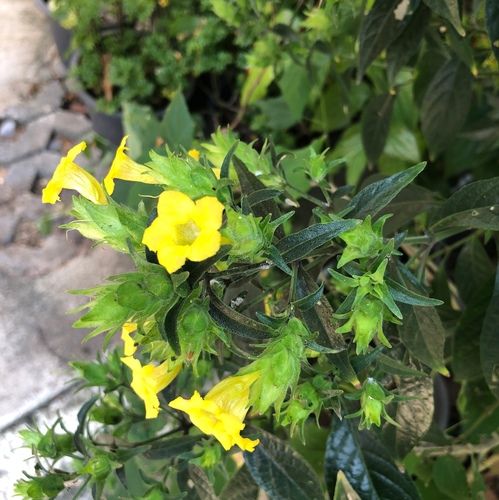
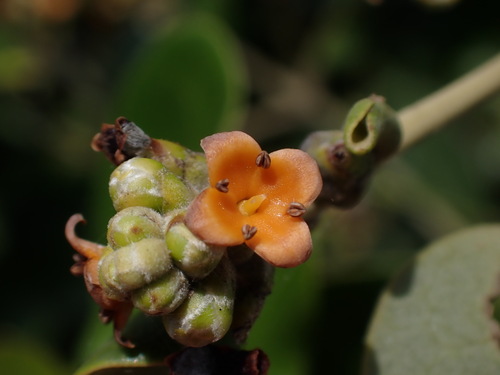
Avicennia marina, commonly known as grey mangrove, grows as either a shrub or tree. It typically reaches 3 to 10 meters (10 to 33 feet) in height, and can grow up to 14 meters (46 feet) in tropical regions. Its structure forms a gnarled arrangement of multiple branches. It has smooth light-grey bark made of thin, stiff, brittle flakes; the bark may appear whitish, which aligns with the species' common name. Its leaves are thick, measuring 5 to 8 cm (2.0 to 3.1 in) long. The upper leaf surface is bright and glossy green, while the lower surface is silvery-white or grey and covered in very small matted hairs. Like other species in the Avicennia genus, this mangrove produces aerial roots called pneumatophores. These roots grow to around 20 cm (7.9 in) in height and 1 cm (0.4 in) in diameter. They let the plant absorb oxygen, which is scarce in the species' native habitat, and also anchor the plant during frequent seawater inundation in the soft substrate of tidal systems. The species' flowers range in color from white to golden yellow, measure less than 1 cm (0.4 in) across, and grow in clusters of three to five. Its fruit contains large cotyledons that surround the new stem of a seedling. This forms a large, fleshy seed that often germinates while still on the parent tree, and falls as a fully developed seedling. Grey mangroves grow stunted in water with too high salinity, but reach their full height in mixed salt and fresh water. This species tolerates high salinity by excreting excess salts through its leaves. Grey mangrove is a highly variable species with multiple ecotypes, and forms that closely resemble other species. It has been reported to tolerate extreme weather conditions, high winds, and various pests and diseases. It acts as a pioneer species in muddy soils with a pH between 6.5 and 8.0, and cannot tolerate shade. This species is distributed along the east coast of Africa, across south-west, south, and south-east Asia, Australia, and the northern parts of New Zealand. It is one of the few mangrove species found in the arid coastal regions of the Arabian Peninsula, where it occurs mainly in sabkha environments in the United Arab Emirates, Qatar, Bahrain, and Oman. It also grows in similar environments on both sides of the Red Sea, in Yemen, Saudi Arabia, Egypt, Eritrea, and Sudan, along the Persian Gulf coast in Qatar and southern Iran. It is a characteristic species of the Southern Africa mangroves ecoregion, and is one of three species present in Africa's southernmost mangroves, located in the estuary of South Africa's Nahoon River at 32°56′S. It is also found in Somalia. In ecology, the lichen Pyrenula dalmatioides, found in the northern North Island of New Zealand, is known to grow almost exclusively on the bark of Avicennia marina.