About Aviceda leuphotes (Dumont, 1820)
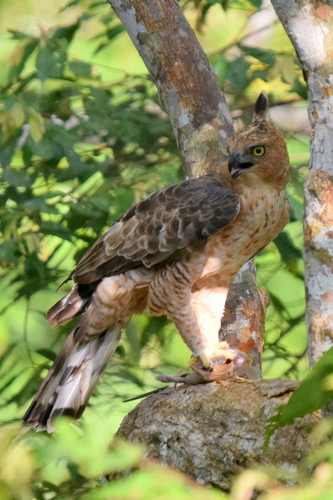
The black baza (Aviceda leuphotes) is a small, distinctively colored raptor. It measures 30 to 35 cm in length, has a wingspan of 66 to 80 cm, and weighs 168 to 224 g. When perched, its upright crest and contrasting patterns make it easy to identify. Males have white markings on the scapulars, secondary coverts, and secondaries, while females only have white on the scapulars, and have more chestnut bands on the underside than the fewer bands seen in males. In flight, it resembles a crow, and migratory individuals are often seen in small groups or flocks. During migration, they gather socially at roost sites. This species is somewhat crepuscular, and is more active at dusk and during overcast weather. Black bazas feed mainly on insects, catching them by making aerial sallies, or by picking insects off leaves, always seizing prey with their feet. They have been observed attempting to catch small birds such as wagtails by dashing into flocks, and they will join mixed-species foraging flocks. They have also been recorded feeding on the fruits of the oil palm. The call of the black baza is described as a "chu-weep" that is somewhat similar to the call of the large cuckoo-shrike; other descriptions note it can also be a soft squeal or whistle, or a shrill gull-like mewing. Like other species in the genus Aviceda, black bazas have two tooth-like indentations on the edge of the upper bill. They are reported to have a disagreeable, "bug-like" odor. This species occurs in Southeast Asia and parts of South Asia, and is migratory across portions of its range. Large numbers of migrating black bazas can be seen at some sites, such as Chumphon in Thailand, where they make up nearly 40% of raptors passing through. In some parts of Hong Kong, small populations have become established as permanent residents in recent times, after previously occurring only as summer visitors. In southern India, the species is regularly seen in winter, mainly in the Western Ghats (where breeding records are questioned), and occurs in the Eastern Ghats mainly during spring passage; breeding is confirmed in northeastern India and Burma. Winter records include stray occurrences in or near major metropolitan areas, such as Guindy National Park in Chennai, and areas near Trivandrum and Bangalore. More recent research indicates the species may be a regular winter visitor to the eastern part of peninsular India, rather than just a passage migrant, and individuals have also been recorded at Point Calimere. Birds in northeastern India begin breeding in April. Both sexes participate in nest building, incubation, brooding, and feeding young. The nest is a firm platform made of thin sticks, with a central depression; it is lined with grass and fiber, and covered on the outside with green leaves. Eggs take about 26 to 27 days to hatch, and insects make up the main food of the chicks.