About Avena sativa L.
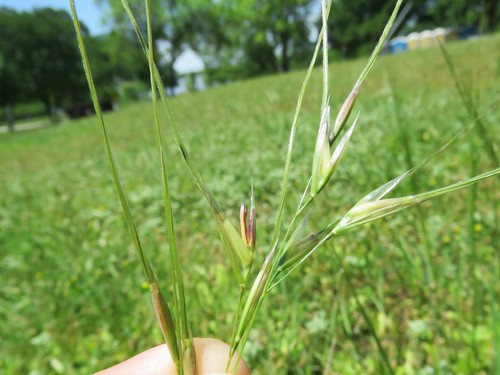
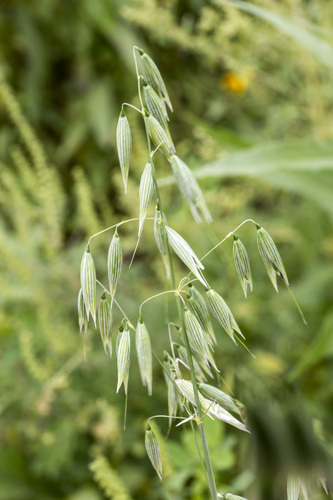
Avena sativa L., commonly known as oat, is a tall, stout grass species in the Poaceae family that can reach a height of 1.8 metres (5.9 ft). Its leaves are long, narrow, pointed, and grow upward, reaching 15 to 40 centimetres (5.9 to 15.7 in) in length and 5 to 15 millimetres (0.20 to 0.59 in) in width. Leaf blades emerge first from nodes on the stalk, followed by the leaf sheath. New leaves grow upward on nodes further from the ground, while leaves on older nodes gradually turn brown and wilt. At the top of the stem, the plant branches into a loose cluster of spikelets called a panicle. These spikelets hold wind-pollinated flowers that mature into oat seeds, also called grains. Botanically, the grain is a caryopsis, meaning the fruit wall is fused directly to the actual seed. Like other cereal grains, the caryopsis consists of an outer husk (bran), a starchy food storage tissue called the endosperm that makes up most of the seed, and a protein-rich germ that can grow into a new plant when planted in soil. Oats are annual plants that grow best in temperate regions. They tolerate cold winters less well than wheat, rye, or barley, and are damaged by sustained temperatures below −7 °C (20 °F). They have a lower requirement for summer heat and greater tolerance of (and need for) rain than the other cereals listed, so they are especially important in areas with cool, wet summers such as Northwest Europe. Oats can grow in most fertile, well-drained soils, and tolerate a wide range of soil types. While better yields are achieved at a soil pH between 5.3 and 5.7, oats can tolerate soils with a pH as low as 4.5. They grow better in low-nutrient soils than wheat or maize, but are generally less tolerant of high soil salinity than other cereals. Traditionally, United States farmers grew oats alongside red clover and alfalfa, which fix nitrogen and provide animal forage. With reduced use of horses for labor and increased use of commercial fertilizers, cultivation of this mixed crop system declined in the US. For example, the state of Iowa led US oat production until 1989, but has largely shifted to growing maize and soybeans. When used for food, oats are most often rolled or crushed into oatmeal, or ground into fine oat flour. Oatmeal is primarily eaten as porridge, but is also used in a range of baked goods including oatcakes (which can be made with coarse steel-cut oats for a rougher texture), oatmeal cookies, and oat bread. Oats are an ingredient in many cold breakfast cereals, most notably muesli and granola; the Quaker Oats Company introduced instant oatmeal in 1966. Oats are also used to produce a plant-based milk substitute called oat milk. As of late 2020, the oat milk market was the second-largest among plant milks in the United States, after almond milk and ahead of soy milk in sales. For centuries until farming practice changes in the 1960s, oats were a staple in West Wales and used in many traditional Welsh dishes, including laverbread (a Welsh breakfast dish) and cockles and eggs served with oatbread. Oat noodles have been a traditional food in Shanxi, China. In Britain, oats are sometimes used for brewing beer; for example, in oatmeal stout, a percentage of oats (often 30%) is added to barley to make the wort. Oatmeal caudle, a mixture of ale, oatmeal, and spices, was a traditional British drink and a favorite of Oliver Cromwell. Oat consumption surged in the United States in the late 1980s, after the Quaker Oats Company began marketing its products as having cholesterol-reducing benefits based on a 1986 study. This "oat bran fad" lasted until 1990, when newer studies questioned the earlier findings. Beyond food uses, oat straw is used as animal bedding, because it absorbs liquids better than wheat straw. The straw can be used to make corn dollies, which are small decorative woven figures. When tied in a muslin bag, oat straw has been used to soften bath water. In biotechnology, proteins derived from oats such as LOV-domains have been used as a basis for technologies including quantum sensors and fluorescent reporters.