About Automolus exsertus Bangs, 1901
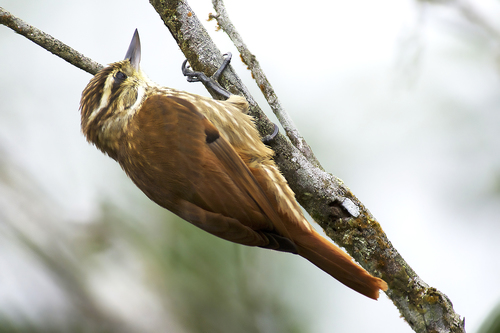
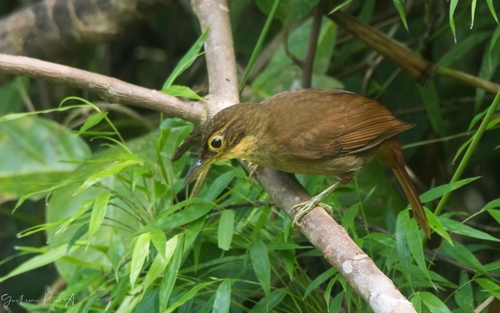
The Chiriqui foliage-gleaner, with the scientific name Automolus exsertus Bangs, 1901, measures 18 to 20 cm (7.1 to 7.9 in) long and weighs 30 to 46 g (1.1 to 1.6 oz). It is a fairly large species within its genus, and has a heavy bill. The sexes of this bird have identical plumage. Adults have a mostly dark brownish face, marked by a prominent buff eyering, faint reddish streaks on the ear coverts, and a slightly buffy malar area. Their crown and nape are dark brown, with a faint blackish brown scalloped pattern. Their back and rump are a rich dark brown that transitions to dark chestnut on the uppertail coverts. Their wing coverts are rich dark brown, while their flight feathers are slightly paler and more rufescent. Their tail is dark chestnut. Their throat is ochraceous-buff, their breast is streaked with medium brown and ochraceous buff (the streaking fades on the lower breast), and their belly is brown. Their flanks are a darker, more rufescent brown, and their undertail coverts are bright rufous. Their iris ranges from brown to dark brown, their maxilla is blackish horn to horn-brown, their mandible is horn to gray, and their legs and feet can be olive, greenish brown, or greenish gray.
The Chiriqui foliage-gleaner is distributed along the Pacific slope, from Costa Rica (south of the dry northwest region) south into western Panama, extending as far as Veraguas Province. It inhabits tropical evergreen forest, mature secondary forest, and coffee plantations, and occurs from sea level up to 1,400 m (4,600 ft) in elevation.