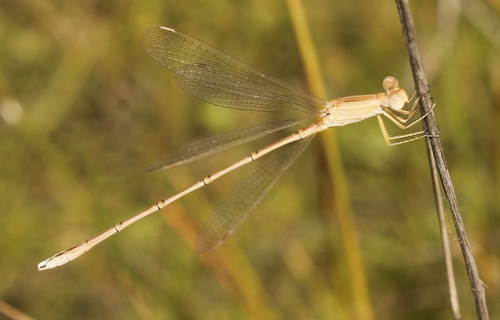
About Austrolestes colensonis (White, 1846)
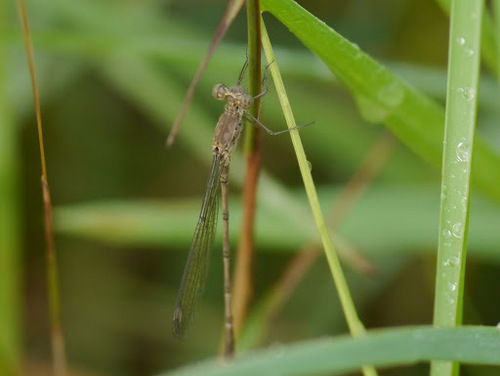
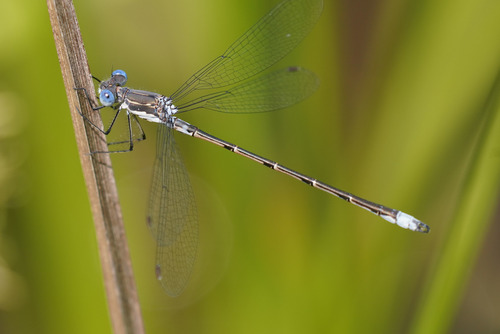
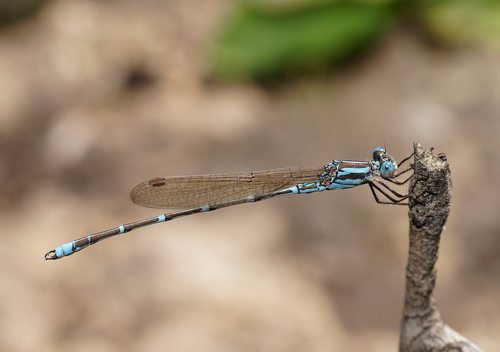
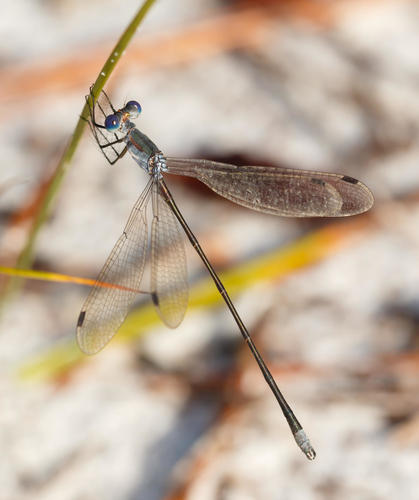
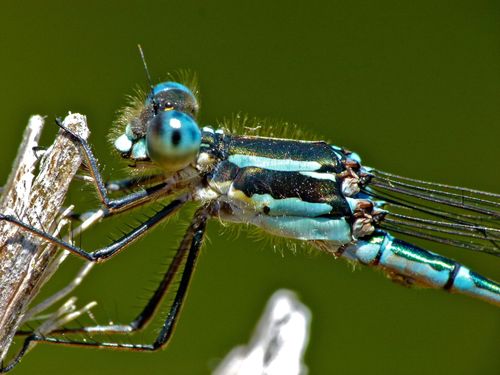
Hudson's original description of this species gives a wing expansion of 2+1⁄8 inches and a body length of 1+3⁄4 inches. For adult males, the general body color is dark purplish-black, marked with bright blue markings. The front of the labium, pronotum, two broad stripes on the mesonotum, and the articulations of both the wings and abdomen are all brilliant blue. The legs are black on the upper side and yellowish-brown beneath. The male's superior appendages are pincer-like, toothed along the inner edge, with an inner tubercle at the base that forms the start of a dilation. This dilation ends in a very sharp tooth around its middle, and the tip of the appendage is inclined downward and slightly curved outwards. The inferior appendages are less than half the length of the superior appendages; they are brown, thick, positioned close together, and slightly tapered. For females, the head and pronotum are dull slaty black. The central portions of the mesonotum have brilliant green edges, first bordered by a narrow white band, then broadly bordered by black. The abdomen is bright green at the base, turning dull purple towards the tip. The end of each segment is marked with a shaded black ring, and the start of each following segment is marked with a sharp, fine white ring. The female's anal appendages are separated, sub-cylindrical, yellowish, shorter than the last abdominal segment, and the valves have slight tooth-like projections at their tips. A. colensonis is the largest damselfly native to New Zealand. Adult males can be identified by their widely separated blue eyes and a pale blue upper border on the mouthparts. The thorax is predominantly black, with three metallic blue stripes separated by the black. Along the abdomen, each segment from two to seven has a blue anterior ring on the margin between segments; the rest of the abdomen is black, except for a dorsal blue area on segment ten. Females are similar in pattern to males, but have a thicker abdomen with long thin appendages at the clubbed tip. Both females and young males are iridescent green rather than blue. Larvae of this species measure between 17 and 21 millimetres in length, with a broad head, large eyes, a cylindrical body, a rounded tip on the tail gill with no hairs, and three horizontal brown stripes. This species is distributed across all of New Zealand, including Stewart Island and Chatham Island. Individuals from Chatham Island are genetically distinct from mainland New Zealand populations, and most have an interrupted blue stripe on the thorax, but this difference is not currently considered enough to classify them as a separate species. A. colensonis can be seen near water at any time of year, but is most commonly encountered from November to April; adults recorded in June and July may be overwintering. It is the dominant damselfly species found in mountain tarns, so it is presumed to be cold-tolerant. This species has a two-year life cycle. Some eggs hatch in the same summer they are laid, while others overwinter in a dormant state and hatch the following spring. Temperature is the main factor that regulates developmental rate; temperatures that are too low cause embryo death. At a temperature of 20 degrees Celsius, eggs hatch in approximately 20–21 days. After hatching, nymphs live for one year to one and a half years before metamorphosis. Before emergence, the nymph darkens until it is nearly black. A few days before emergence, nymphs may make several short trips out of the water. Emergence typically occurs on rush or grass stalks 10–40 cm above the water line. High mortality is common during emergence, as moulting adults may lose their grip on the substrate and fall into the water to drown. Emergence takes place during the day, between the months of October and February, with most emergence occurring around January. Even so, adults can be found as late as May in Dunedin and as early as June in Northland. After emergence and the first flight, young adults take several days to reach sexual maturity; this period is associated with high rates of dispersal. Once males reach maturity, they travel to find suitable breeding habitat and establish territories, where they remain motionless on their fixed perch for long periods until disturbed by an intruder. During early afternoons, the peak of reproductive activity, males will chase females that fly through their territory. The mating wheel lasts for 10 minutes, and egg-laying usually occurs while the pair remains connected in tandem. The pair lands on floating vegetation, and the female cuts a shaft through the plant stem into the pith, then lays 6–9 eggs, a process that takes up to one minute. This process repeats, and eggs are laid either in close batches or spaced apart. After hatching, young nymphs (called pronaiads) search for water, where they moult into the second larval instar, which measures about 2.3 mm long. These young nymphs are active swimmers; when they reach later instars, they move across the surface of detritus and vegetation on the bottom of ponds.