About Austroderia richardii (Endl.) N.P.Barker & H.P.Linder
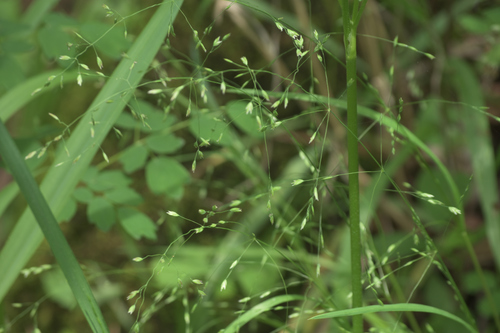
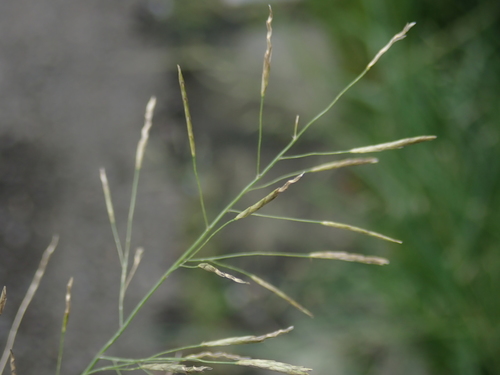
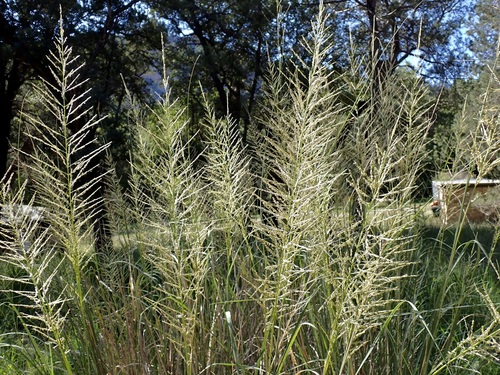
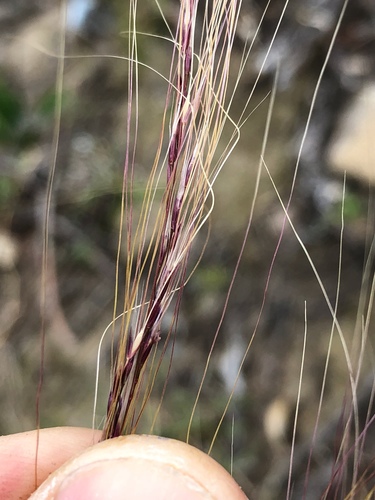
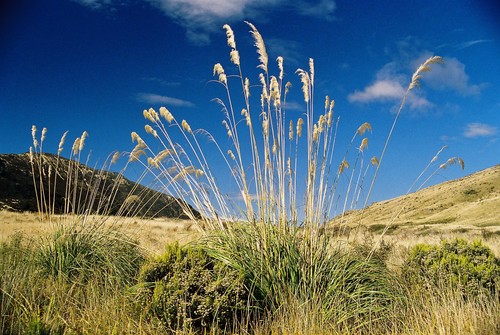
Austroderia richardii (Endl.) N.P.Barker & H.P.Linder is a large grass species that reaches 1.5 to 3 m in height. Its leaves are coarse, green, flat, and narrow, growing up to 1 m long and 2 to 5 cm wide, with fine, sharp teeth along the edges that give the species the common nickname "cutty grass". It produces upright flowering culms (the hollow stems of flowering grass) up to 2.5 m tall, which are its main identifying feature. Each culm holds a large, arching, dense, silvery plume at the top that makes the species stand out from other members of the genus Austroderia. The flower head is typically one-sided and drooping, with many fine hanging branches that hold numerous small flower clusters enclosed in soft, hairy scales. Plumes range in colour from creamy buff to yellowish, grow 30–60 cm long, and have a loose, open appearance that gives the species its distinctive thick, soft plume-like flower head. The leaves have multiple prominent veins running along either side of the midrib, making them tougher and stronger than the similar-looking introduced pampas grass, a key trait for distinguishing the two species. A. richardii typically flowers from spring to early summer, between September and November, and retains its plumes year-round. Fruiting occurs between October and March. All Austroderia species in New Zealand, including introduced ones, are confirmed to be gynodioecious: this means populations have both male-sterile individual plants and hermaphroditic individuals, and hermaphrodites may be self-compatible. Hermaphrodite plants have large pollen-filled anthers and small gynoecia (the female flower parts), while female plants have flat, white or transparent sterile anthers and larger gynoecia. Both sexual forms produce seeds, which are dispersed by wind. A. richardii is endemic to New Zealand, and has been introduced to Tasmania, Australia. Within New Zealand, it is currently confined to the South Island, though it may possibly grow in the North Island east of Cape Palliser. It is a hardy, tolerant species that adapts to a wide range of habitats, including streamsides, wetlands, scrubland, and coastal sand dunes. It grows well in both moist and dry soils, as well as sand, and can tolerate very poor soils such as the sand of coastal dunes and thrive in frost-prone regions. It is well suited to coastal environments, where it withstands poor dune soils, coastal wind, and precipitation, such as conditions found on the west and east coasts of the South Island. While it tolerates many environmental conditions, it prefers areas near water, indicating it favours high moisture uptake. Even though it grows best in moist soil, it can tolerate nutrient-poor soils dominated by sand, clay, or pumice, which lack nutrients due to holding too little or too much moisture. A. richardii is primarily eaten by herbivores, including a wide range of New Zealand endemic and introduced bird species, which mostly feed on its seeds from spring- to summer-flowered plumes. The species is not poisonous, but most herbivores do not tend to eat its leaves due to their sharp edges and tiny teeth that give the species its "cutty grass" nickname. It also has low palatability for introduced herbivores, meaning its taste is not appealing to these animals. Some grazing livestock do eat the leaves, but this level of consumption does not threaten the species. A. richardii is widely cultivated in temperate regions for its silvery white inflorescence plumes, which emerge in summer and persist well into winter, and can grow up to 60 cm long. Like related species, it is commonly used in dried flower arrangements. It has been awarded the Royal Horticultural Society's Award of Garden Merit. It is the only native New Zealand Austroderia species offered for sale within New Zealand, where it is sold for ornamental value. It is not widely available, so can only be obtained through nurseries that specialise in native plants. A. richardii typically grows in clumps of around five to six plants, a growth pattern likely resulting from its wind-based seed dispersal. Its large, hardy clumps make it an effective windbreak for livestock. Botanists and gardeners often remove old, non-flowering stalks to maintain a more attractive ornamental appearance, both in gardens and natural habitats. To break seed dormancy, it is recommended that seeds undergo cold stratification: seeds are soaked in water overnight, drained, then kept moist in a refrigerator for approximately four weeks, after which they are ready to germinate and grow into seedlings. Toetoe (A. richardii) can also be propagated by division; juvenile plants divide easily and grow more successfully than mature plants.