About Austrocidaria similata (Walker, 1862)
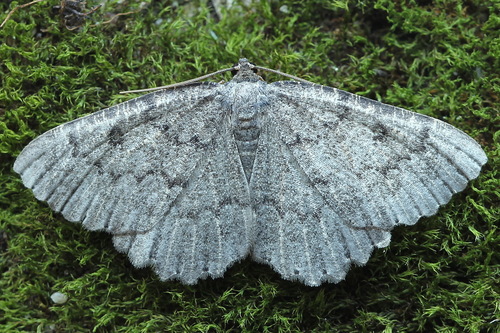
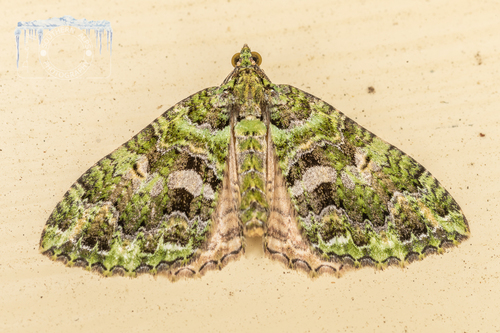
The scientific name of this species is Austrocidaria similata (Walker, 1862). Eggs of this species are white and oval-shaped, taking approximately three weeks to mature. Hudson provided the following description of this species' larvae. The larva, which feeds on Coprosma robusta and C. rotundifolia, reaches about 1 inch in length. It is rather stout, slightly narrowed at both ends, and dull brown, thickly speckled and streaked with blackish. The central portions of the three thoracic segments are green, as is a series of prominent dorsal ridges on the posterior margins of the other segments. The spiracles are black with white margins, and the legs and prolegs are pale green. In younger larvae, the dorsal ridges are much less conspicuous, and whitish tubercles are often present on segments 7, 8, 9, and 10. Hudson notes that the larva resembles a small twig covered in moss, which makes it hard to detect on its food plant. He also believed that this species overwinters in the larval stage. Hudson described the pupa as being enclosed in a thin cocoon made of silk and debris, located on the ground surface. Hudson also provided the following description of the adults: The wingspan is 1+1⁄4 inches. The fore-wings are dark greyish-brown or purplish-brown, with veins and margins broadly marked with bright green. Numerous irregular wavy blackish streaks form three very poorly defined darker transverse bands: the first at the base, the second from roughly one-fourth to two-thirds of the wing length (usually with a paler central area), and the third near the termen, with an outer white edge. There is a series of fine black terminal marks, and the cilia are dark brown. The hind-wings are cream-coloured with a very pale reddish-brown tint, darkening toward the dorsum, with numerous pale brown wavy transverse lines. There is a series of black crescent-shaped marks on the termen, and the cilia are pale reddish-brown. This species is similar in appearance to A. callichlora, but can be distinguished from it by a purple-grey marking at the point where the forewings meet. It can also be distinguished by two white oblong patches on the bottom of its forewings near the abdomen when the wings are at rest. Hudson states that this species can commonly be found resting on moss-covered tree trunks, and its colouring provides camouflage to protect it from predators. Austrocidaria similata is endemic to New Zealand. It is found on the Auckland Islands, Campbell Island / Motu Ihupuku, Snares Islands, the Chatham Islands, mainland New Zealand, Stewart Island / Rakiura, and Codfish Island / Whenua Hou. This species lives in native forest and shrubland where its larval host plants grow. The larvae feed on Coprosma species.