About Austrocidaria callichlora (Butler, 1879)
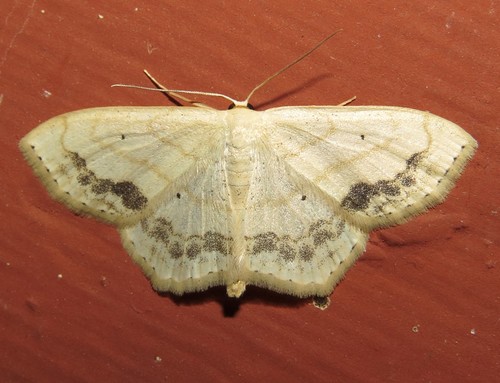
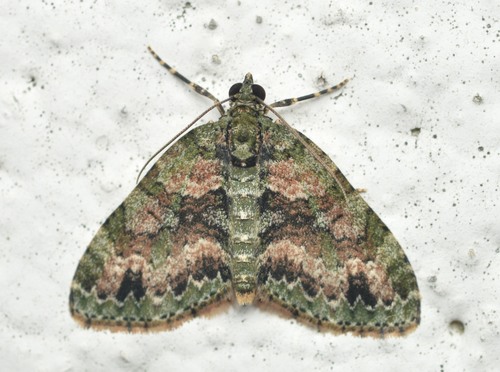
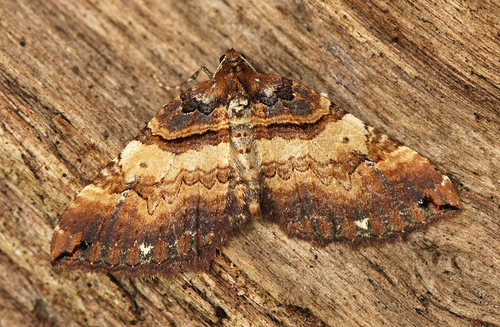
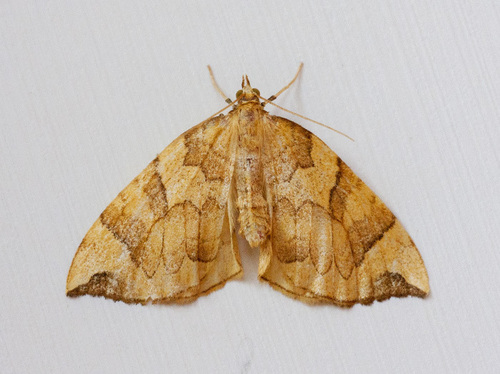
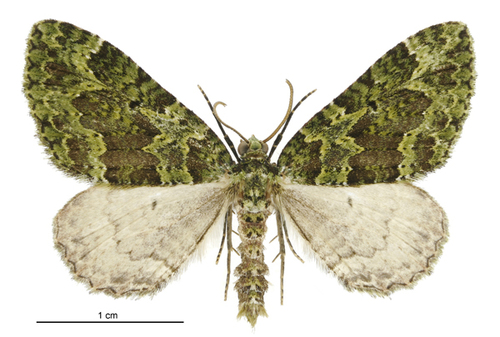
Hudson described the larvae and pupae of Austrocidaria callichlora as follows. The very handsome full-grown larva, which feeds on Coprosma rotundifolia during the summer months, is about 1 inch long, moderately slender, slightly flattened, and of almost uniform thickness. It is very bright green, much paler on the ventral surface; it has a conspicuous crimson lateral line that is sometimes edged with white, and the prolegs are also crimson. The segmental divisions are marked in yellow, and there are a few isolated black bristles. Younger larvae have a dull greyish-green ground colour, whitish underneath, and the crimson stripe is much fainter than in full-grown larvae. The pupa is enclosed in a fragile cocoon made of several leaves joined together with silk, and is usually located on the ground surface. When Butler first described this species and named it Cidaria callichlora, he stated it is nearly allied to the European C. miata, and differs from C. miata in the following ways: the upper side of the primaries is more densely green; the basal patch is smaller and darker, and less angular; the central belt is wider, its inner edge is less sharply defined, its outer edge is widely zigzag from above the second median branch; the white submarginal spots are replaced by a pale greenish festooned line; the double marginal black dots are replaced by arrow-shaped markings pointing inward. Secondaries are crossed by two widely separated, indistinct, dentate-sinuate grey discal lines; there is no discocellular dot; the abdomen is pale brown with white dorsal dots, each flanked by black dots on either side. There are similar differences on the undersides of the wings, but all wings here have black discocellular dots. Butler recorded the wing expanse as 1 inch 3 lines. This species is similar in appearance to A. similata, but it lacks the purple-grey coloured mark present where the forewings meet in A. similata. It is also visually similar to Austrocidaria praerupta, and George Hudson mistakenly discussed A. praerupta as a synonym of A. callichlora. The wingspan of adult A. callichlora is between 24 and 34 mm. Adults are variable in wing colouration. Specimens collected from Fiordland are particularly intensely coloured, and some have shades of blue and green on their wings. A. callichlora is endemic to New Zealand, and can be found on both the North and South Islands. This species occurs in native shrubland, forest, and tussock areas, most commonly where its host plants are abundant. The larvae of A. callichlora feed on Coprosma species, including Coprosma rotundifolia and Coprosma robusta.