About Austroboletus occidentalis Watling & N.M.Greg.
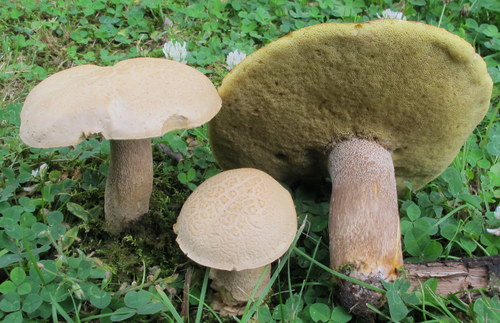
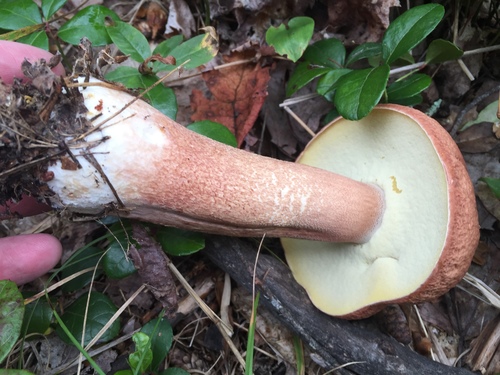
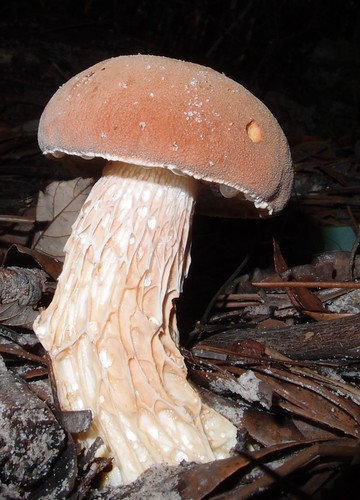
Austroboletus occidentalis, commonly known as the ridge-stemmed bolete, is a species of bolete fungus found in Australia. It was formally described as new to science in 1986 by mycologists Roy Watling and Norma M. Gregory. Its specific epithet occidentalis comes from the Latin word occidens, meaning "west". The fruit body of this fungus has a cap between 5.5 and 10 cm in diameter. The cap has a texture similar to suede or chamois, and can be sticky or slimy when young. Young caps are initially orange or pinkish-brown, subconical in shape with a thickened margin; as the mushroom ages, the cap flattens and fades to an ochre colour. Like other bolete species, it has tubes under the cap instead of gills. These tubes are white in young specimens, and mature to a pink colour. The stipe is cylindrical and white, measuring 7 to 16 cm tall and 1.7 to 2.5 cm wide, and is marked with deep pits called lacunae. The white flesh of the mushroom bruises yellowish when damaged, and has a bitter taste. Its edibility is currently unknown. The spore print is brown, while the spores themselves are cylindrical, measuring 15–19 μm by 5–6.5 μm, and are entirely covered with warty lumps. This species grows as a component of jarrah (Eucalyptus marginata) forests in southwestern Western Australia, and has also been recorded in coastal scrub in southeastern Tasmania. Austroboletus occidentalis forms a newly described type of plant-fungus symbiosis called feremycorrhiza with a wide range of hosts, including woody plants such as jarrah, herbaceous plants such as wheat and barley, and even non-mycorrhizal plants such as canola. The prefix "fere-" means "nearly" in Latin, so the term feremycorrhiza translates to "nearly mycorrhiza". This Australian native fungus phylogenetically belongs to a biotrophic ectomycorrhizal (ECM) lineage, and has several established characteristic features of ECM symbiosis. However, A. occidentalis does not enter plant roots and does not form any interface structures within roots, so it is not a fully developed structurally complete mycorrhiza, qualifying as "nearly" mycorrhiza, while still producing mycorrhiza-like effects on plant growth and plant nutrition. Austroboletus occidentalis belongs to the ECM family Boletaceae, and shares several typical traits of ECM fungi: it has strong phosphorus solubilization activity, has biotrophic traits including a low number of plant cell wall degrading enzyme (PCWDE) genes, and lacks invertase (sucrose-hydrolyzing) enzymes. Because feremycorrhizal symbiosis formed by this species does not involve root colonization, it can associate with a broader range of host plants including woody and herbaceous species, and both mycorrhizal and non-mycorrhizal plants, compared to ectomycorrhizal fungi such as ECM-forming Austroboletus species, which are generally limited to associating only with woody plants.