About Austramathes purpurea Butler, 1879
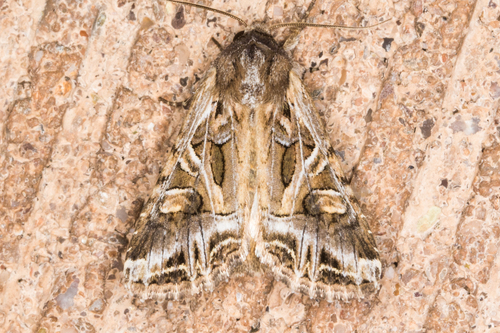
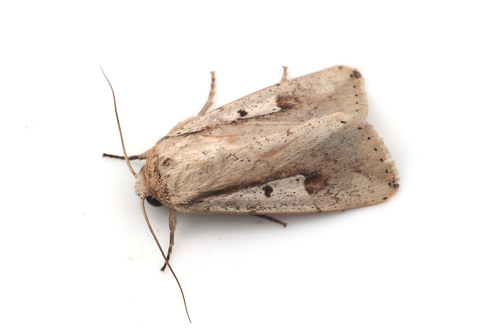
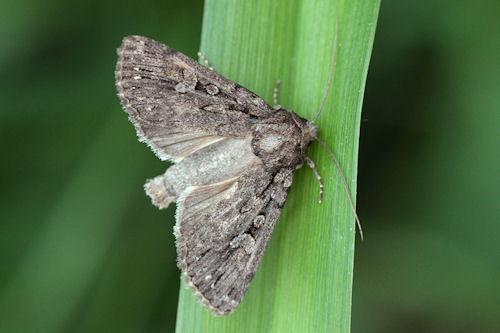
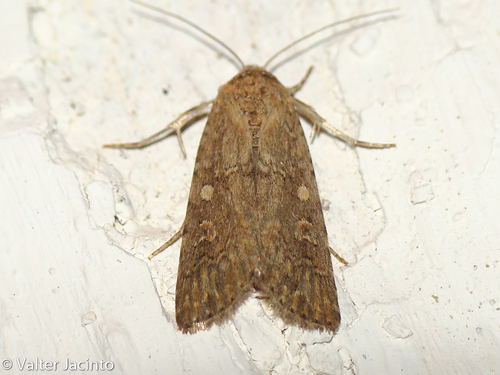
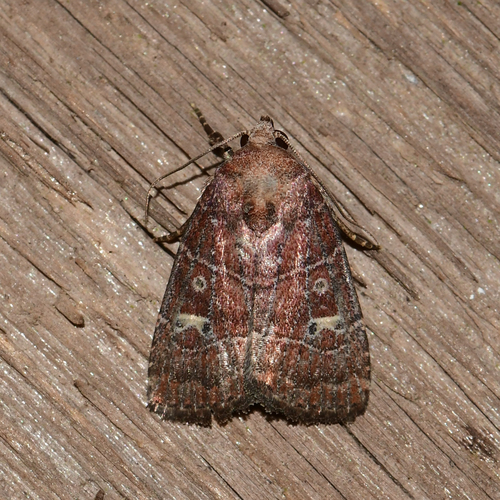
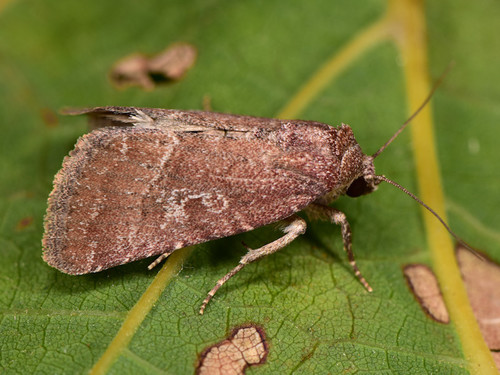
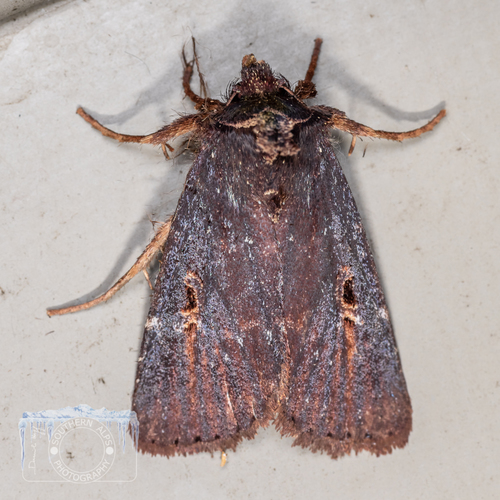
Austramathes purpurea was first described by Butler in 1879. The larvae of this species are green with orange, black, yellow and pink markings. George Hudson gave the following description of the full-grown larva: it is about 1+1⁄4 inches long, moderately stout and of uniform thickness. The head is ochreous, with a black stripe on each side. The back of the larva is greyish-green, and the under surface is pale greenish-ochreous. There is a rather large, shining black mark above each spiracle. The dorsal, sub-dorsal and lateral lines are orange-yellow and very conspicuous, with the two upper lines being very much broken. There are several minute black warts below the spiracles, and a series of very small black marks on the orange dorsal line. Butler's original species description of the adult is as follows: Primaries above are rich chocolate-brown with a purple sheen; the central area is bounded by two undulated squamose lines made of white and fulvous scales, with a third similar but less distinct line across the base. A semicircular blackish spot edged with whitish sits near the end of the cell, its outer edge, along with a portion of the outer undulated line, marks the reniform spot. Its inner edge joins at the tip to an oblique black-edged whitish dash that takes the place of the orbicular spot. There is an indistinct series of black marginal dots. Secondaries are chocolate-brown, turning pale brown towards the base. The fringe is pale brown crossed by a darker line. The head, collar, and centre of the thorax are rich chocolate-brown edged with fulvous scales. The first joint of the palpi is tipped with fulvous. Tegulae are dark brown with a silky slaty-grey sheen. The abdomen is chocolate-brown with pale basal tufts. The under surface is pale silky red-brown with darker margins and fringe. Primaries have a whitish interno-basal area. Secondaries have a lunule at the end of the cell and a bisinuated discal series of black spots. The body below is darker than the wings, and is chocolate-brown. The wing expanse is 1 inch 7 lines. Hudson also described the species in his 1898 book New Zealand moths and butterflies (Macro-lepidoptera): The expansion of the wings is 1+1⁄2 inches. The forewings are rich, glossy reddish-brown with several scattered whitish scales; there is a distinct yellow mark on the costa at about one-fourth, forming the start of a broken transverse line; the orbicular spot is small, round and yellowish; the reniform spot is small, crescentic and yellowish, and the area between the orbicular and the reniform is very dark blackish-brown; beyond the reniform there is a conspicuous white mark on the costa forming the start of a second broken transverse line; a third shaded line is located near the termen. The hind-wings are pale brown with a dark spot in the middle, which is very conspicuous on the under surface. The wingspan of adult male A. purpurea is between 29 and 37mm, while the wingspan of adult females is between 29 and 42mm. This species may potentially be confused with A. pessota, but A. pessota does not have the purple hue on the forewings that A. purpurea has. A. purpurea is endemic to New Zealand, found in both the North and South Islands, but has not yet been recorded at Stewart Island. This species lives preferentially in native forest habitat.