About Austracantha minax (Thorell, 1859)
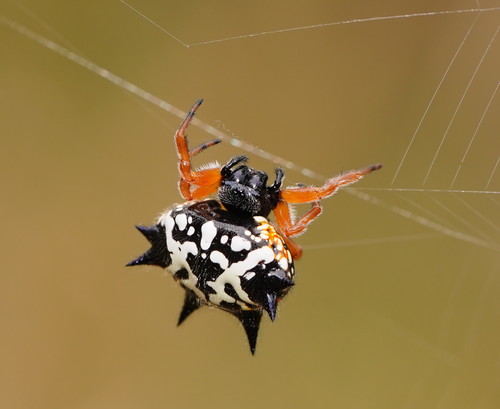
Austracantha minax, commonly called jewel spiders, have a distinctive appearance that makes them relatively easy to identify. Their cephalothorax is black with a bluish metallic sheen, and is covered with small white setae (hairs). The carapace, the upper part of the cephalothorax, is rectangular in shape. The sternum (chest) is brownish black, with a yellow central area. The chelicerae (fangs) are black with four to six small teeth. The maxillae and other mouthparts are black at the base, lightening to brown and bright yellow at the tips. The pedipalps are dark brown. Jewel spiders have eight eyes arranged in two rows. The front row is recurved, with the two middle anterior median eyes further in front than the two side anterior lateral eyes. The back row is procurved, with the two middle posterior median eyes further back than the two side posterior lateral eyes. Female legs are predominantly dirty yellow to orange in color, with black tips on the last three leg segments: tibiae, metatarsi, and tarsi. The first pair of legs is longer than the other pairs. In males, legs are mostly black, with brownish tips. The opisthosoma (abdomen) is large, slightly wider than it is long, and strongly rounded at the front and back. It is shiny black with bright, variable color patterns that are usually white, yellow, or yellow-orange. Its most distinctive feature is three pairs of large outward-projecting spines. The first two pairs on the front are positioned close to each other, forming a V-shape as they point to the sides; they are short and roughly conical. The rear spines are longer, point backwards, and are separated by wide gaps from the two front pairs. The upper surfaces of the spines are black or brownish black, while their lower surfaces are yellow-orange to rusty red. Jewel spiders are sexually dimorphic. Females are about twice as large as males, reaching 7 to 12 mm (0.28 to 0.47 in) in total length. Their carapace is squarish, usually around 2.7 to 3 mm (0.11 to 0.12 in) long and 2.5 to 3 mm (0.10 to 0.12 in) wide. Males are usually only around 3 to 5 mm (0.12 to 0.20 in) in total length. Their carapace is slightly rectangular, usually around 2.1 mm (0.08 in) long and 1.8 mm (0.07 in) wide. Males are also less colorful than females, with predominantly dark reddish brown bodies. Their spines are blunt and much shorter than the spines of females. Like all mature male spiders, they are relatively easy to identify by their greatly enlarged pedipalps, which are used for sperm transfer during mating. Jewel spiders exhibit color polymorphism, and can be found in white, yellow, or red color morphs. Jewel spiders found later in autumn, from March to April, are sometimes melanistic, with an entirely dark brown to black coloration. It is believed that these color morphs are triggered by environmental factors rather than genetics; for example, it has been speculated that melanistic color morphs help facilitate better heat absorption during colder months. Jewel spiders are endemic to Australia. They can be found throughout the Australian mainland, as well as on surrounding islands including Tasmania, Barrow Island (Western Australia), and the Montebello Islands. They are more common in the southern regions of the continent, ranging from southern Queensland and New South Wales, through Victoria and South Australia, to Western Australia. Though they can be found in the Northern Territory, they are less common there, and their niche is usually filled by species from the genus Gasteracantha instead. After locating a receptive female, male jewel spiders begin courtship by attaching a mating thread from nearby plants to the edge of the female's orb web. The male then positions itself in the middle of this thread and begins strumming it with its first and second pair of legs. The female responds by moving toward the source of the vibrations, eventually climbing onto the mating thread itself. Once this occurs, the male wraps its legs around the female tightly and inserts its pedipalps into the female's epigyne, transferring its spermatophores (silk packets containing sperm) into the female's spermathecae. A female jewel spider can mate with multiple males during a single reproductive cycle. If given the chance, the female will still readily mate with other males shortly after a successful mating. To prevent sperm competition, the successful male defends the female shortly before and after mating, actively driving away other rival males until the female enters a refractory period and ceases to be receptive to further matings. This usually happens one hour to one day after a successful mating, during which the female will herself aggressively attack and drive away all courting males. Females usually attach their egg sacs to vegetation and other surfaces near the edges of their webs, including grass blades, leaves, and twigs. Egg sacs are usually bound longitudinally with loose lengths of silk, but they can sometimes be found dangling. The egg sacs are around 15 to 35 mm (0.59 to 1.38 in) in length and can vary in shape from circular to pointed at both ends. They are reddish brown to golden brown in color, though rarely they may also be bright yellow. They are made from closely woven silk. Spiderlings overwinter within the egg sacs until early spring. Females reach sexual maturity around mid-January, while males mature earlier, in mid-December.