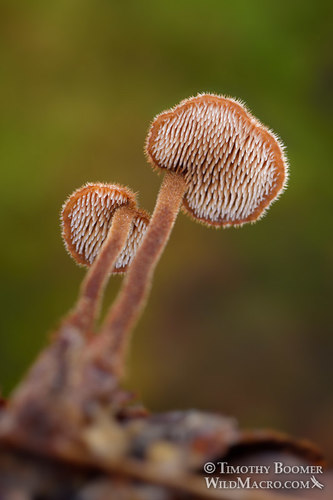
About Auriscalpium vulgare Gray
Auriscalpium vulgare Gray, commonly known as the pinecone mushroom, has fruit bodies that are fibrous when fresh and become stiff when dry. This small species rarely exceeds 5.5 cm (2+1⁄4 in) in height. Its cap is usually smaller than an adult's fingernail, ranging 0.5 to 2 cm (1⁄4 to 3⁄4 in), though it can grow up to 4 cm (1+1⁄2 in) across. The cap is semicircular or kidney-shaped, flat on the lower surface and rounded on the top. When young, its surface matches the stem: covered in bristles and colored dark chestnut brown. As it matures, the surface becomes smoother and can darken to almost black. The cap margin is typically buff to light brown, matching the color of the spines and lighter than the cap center. In maturity, the margin rolls inward (revolute) and often becomes wavy. The spines on the cap underside are a few millimeters long, cylindrical, and end in sharp tips. When young, they are white to light brown; later they become covered in a white spore mass, and eventually turn ashy gray. Occasionally, fruit bodies grow with no cap at all. A. vulgare usually has a single stem, but sometimes multiple stems grow from a thick shared base. The stem attaches to the side of the cap, is cylindrical or slightly flattened with a bulbous base, and measures 2–8 cm tall and 1–3 mm wide. Its surface is covered in hairy fibers, and mature stems are dark chestnut brown. The cap flesh has two distinct layers: a thin, compact, black-brown, hairy upper layer, and a thick, soft, white to light brown lower layer made of thin thread-like filaments arranged roughly in parallel. The stem has a similar layered structure: a thin, dark, hairy outer cortical layer covered in hairs surrounds an inner ochre-colored flesh. A drop of potassium hydroxide applied to the mushroom surface causes an instant black stain. The mushroom has no distinct taste or odor, and is generally considered inedible due to its toughness and small size, though an 1887 textbook noted it was commonly eaten in France and Italy. In spore deposits, spores are white. When viewed under a light microscope, spores are hyaline (translucent), covered in tiny wart-like bumps, spherical or nearly spherical, with dimensions of 4.6–5.5 by 4–5 μm. They are amyloid (react to Melzer's reagent) and cyanophilous (stain in methyl blue). The basidia (spore-bearing hymenial cells) are four-spored with basal clamps, measuring 15–24 by 3–4 μm; the sterigmata (basidia extensions that hold spores) are swollen at the base and roughly 3 μm long. The hyphal system is dimitic, containing both generative (undifferentiated) and skeletal (structural) hyphae. Thin-walled generative hyphae are hyaline and have clamp connections, while thick-walled skeletal hyphae are thicker overall and lack clamp connections. The cortex (the tough outer flesh layer) is made of parallel unbranched brown generative hyphae that are thick-walled, clumped together, and frequently clamped. The internal flesh is made of interwoven generative and skeletal hyphae. Gloeoplerous hyphae (containing oily or granular contents) are also present, protruding into the hymenium as club-like or sharp-pointed gloeocystidia. The hyphae of basidiomycetous fungi are divided by cross-walls called septa, which have pores that allow cytoplasm or protoplasm to pass between adjacent hyphal compartments. In a study to identify ultrastructural characters useful for systematic and phylogenetic analyses of the Agaricomycotina, Gail Celio and colleagues used electron microscopy to examine septal pore structure and nuclear division in A. vulgare. They found that septa in hymenial hyphae have bell-shaped pore caps with multiple perforations. Each cap extends along the full length of the septum, alongside an organelle-free zone surrounding the pore. Because similar data from other Agaricomycotina species is scarce, it is not known whether the extended septal pore cap margins of A. vulgare are useful for phylogenetic analysis. Regarding nuclear division, metaphase I of meiosis is similar to mitotic metaphase. Spherical spindle pole bodies containing electron-opaque inclusions are positioned within gaps on opposite ends of the nuclear membrane. The membrane has occasional gaps but is mostly continuous. Fragments of endoplasmic reticulum occur near the spindle pole bodies, but do not form a cap. Auriscalpium vulgare is a saprobic species. Its mushrooms grow singly or clustered on fallen pine cones, especially those that are fully or partially buried. It typically favors Scots Pine (Pinus sylvestris), but has also been reported growing on spruce cones, and in California it grows primarily on Douglas-fir cones. One author recorded finding the mushroom on spruce needles atop squirrel dens where cone bracts were present in the forest floor. In a study of the Laojun Mountain region of Yunnan, China, A. vulgare was found to be one of the most dominant species collected from mixed forest at an altitude of 2,600–3,000 m (8,500–9,800 ft). A study of the effects of slash and burn practices in northeast India found that the fungus prefers to fruit on burned cones of the Khasi Pine, and that the number of fruit bodies on unburned cones increases with the girth of the cone. The fungus is widely distributed across Europe, Central and North America, temperate Asia, and Turkey. In North America, its range extends from Canada to the Trans-Mexican Volcanic Belt south of Mexico City. The mushroom is common, and fruits in summer and autumn, though it is easily overlooked due to its small size and nondescript coloration. A. vulgare is the only representative of its genus found in temperate areas of the Northern Hemisphere.