About Aureoboletus betula (Schwein.) M.Kuo & B.Ortiz
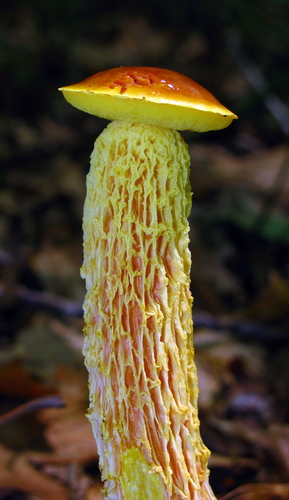
This species, Aureoboletus betula, has a 2–5 centimetre (3⁄4–2 in) wide cap that is convex when young and broadens as it ages. The cap starts golden yellow, and discolours to brownish yellow or reddish orange as it matures. The cap surface has a sticky texture, and its internal flesh is yellow. Aureoboletus betula has 1–2 pores per millimetre, attached to pores tubes that grow 1.5 cm deep. The pore surface is bright yellow, turning greenish yellow with age. The stem grows 8–15 cm (3+1⁄4–6 in) tall and 1–2 cm thick. It has a distinct textured surface marked by deep ridges, with a slightly swollen, rooting base. The internal flesh of the stem is white, and stains pink when cut and exposed to air. The taste and smell of the fungus have no distinct characteristics. Its spores are ellipsoid in shape, measuring 16–24 by 7–12 micrometres, and it produces an olive-coloured spore print. This fungus grows under oaks, or in mixed pine and oak woodlands. It is found primarily in the southern Appalachians, and fruiting occurs from July to September.