About Attulus penicillatus (Simon, 1875)
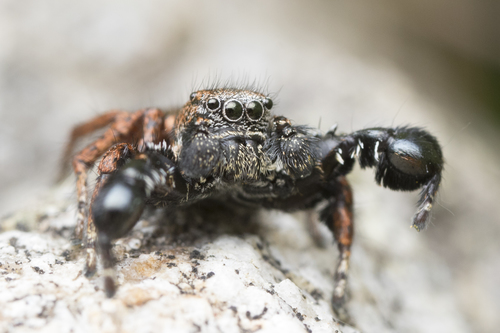
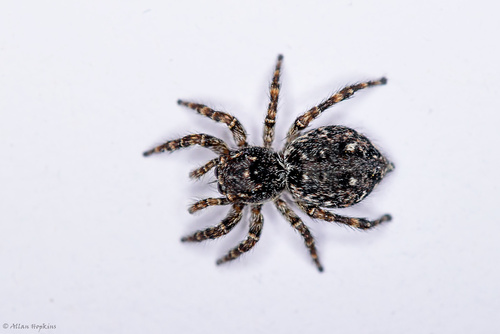
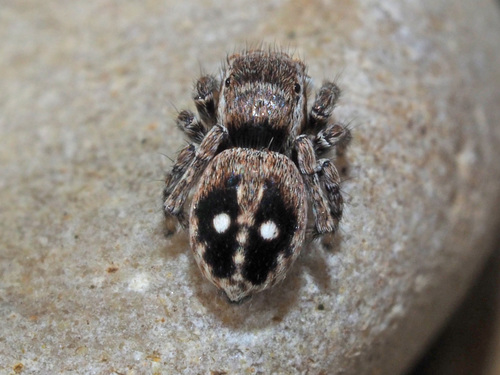
Males of Attulus penicillatus have a cephalothorax length of 1.50–1.75 mm and an opisthosoma length of 1.40–1.45 mm. The anterior eye row width measures 1.00–1.09 mm, while the posterior eye row width is 0.97–1.04 mm. The eye region length ranges from 0.57–0.70 mm. The male cephalothorax is dark brown, and the male opisthosoma bears two distinctive circular white spots. Specific coloration and bristle patterns are present on the legs: bristles occur on the coxa, trochanter, patellae of legs I and III, posterior patellae, and legs II and IV. The sides of the male cephalothorax have white hairs. The male eye region has brown bristles with brown and green metallic luster, with brown bristles at its front end. Male pedipalps have characteristic features: the tibia and posterior tibia are yellow, and the posterior tibia bears two pairs of bristles. The tibia has 5 small bristles, while the tarsus has 3 small bristles. Other male legs are gray-yellow with gray ring patterns near the joints and additional bristles. Females are larger, with a total body length of 3.32 mm. The female cephalothorax is brown, covered with gray-brown hairs, and the female eye region is dark brown. The anterior and posterior eye rows are equal in width in females. Female chelicerae are light brown, with 4 promarginal teeth and no retromarginal teeth. The female sternum is gray-brown, and the labium and lower lip are dark brown. Female legs are gray-brown. The dorsum of the female opisthosoma is dark brown and lacks markings. The ventral side of the female opisthosoma is gray-brown, and the spinnerets are the same gray-brown color. The female epigyne has a narrow but prominent central septum, with copulatory openings located on both sides of the central septum. Attulus penicillatus has an extensive distribution across the Palearctic region. It occurs throughout Europe, extends eastward through the Caucasus and Russia to the Far East, and extends south through Central Asia to China, Korea, and Japan. Attulus penicillatus inhabits various terrestrial environments. In Europe, it has been recorded in steppe localities on calcareous bedrock, where it exhibits a distinct overwintering behavior. The species has been observed overwintering in empty land-snail shells, particularly those of Caucasotachea vindobonensis and Xerolenta obvia.