About Atta texana (Buckley, 1860)
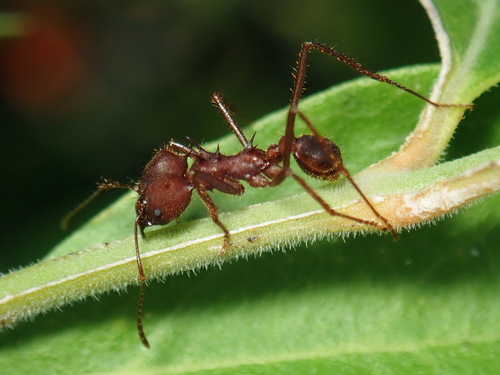
Atta texana (Buckley, 1860) worker individuals are 4 to 14 mm (0.16 to 0.55 in) long and are highly polymorphic. Three pairs of spines sit on the back of the thorax. This ant has a narrow waist and a rusty brown color. Its close relative Atta mexicana forms colonies of up to 8 million individuals, and A. mexicana queens are larger than A. texana queens. A. mexicana only ever has a single queen per colony, while A. texana can have multiple queens, most often two. This trait makes A. texana polygyne, and due to this, the species can form enormous super colonies that hold more than 10 million total individual ants. Because these ants can form such massive super colonies, they are known to disrupt local environments and act as problematic pests for humans living near the colonies. For the life cycle of A. texana: queens lay eggs, which hatch into cream-colored larvae. Once fully developed, larvae measure 1⁄4 to 1⁄2 inch (0.64 to 1.27 cm) long before forming pupae. In spring, some larvae develop into larger winged reproductive male and female ants that reach 3⁄4 inch (1.9 cm) in length. Males have much smaller heads than females, and both sexes have long, smoky black wings.