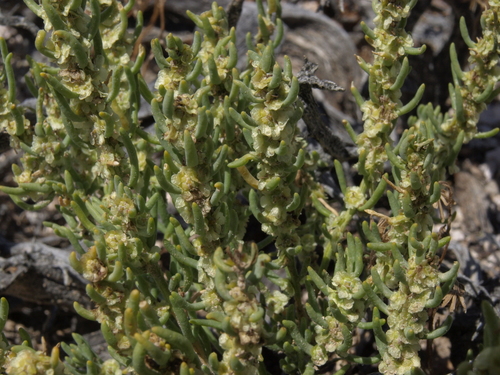
About Atriplex tatarica L.
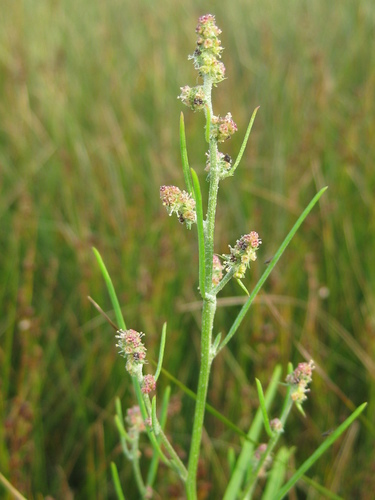
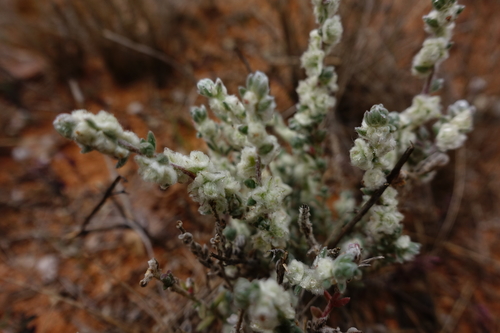
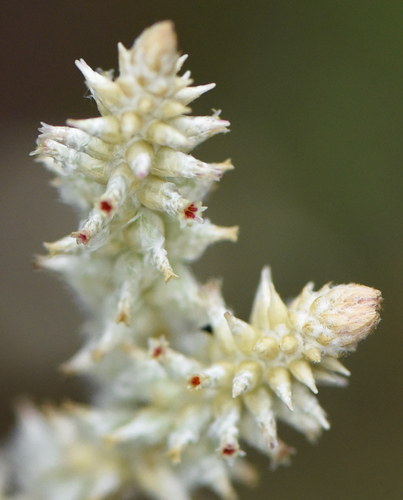
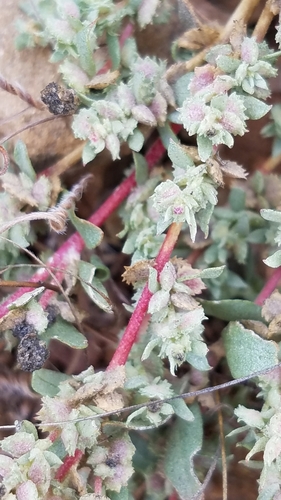
Atriplex tatarica is an annual plant with a white, branched taproot. Its height ranges anywhere from 10 centimeters (3.9 inches) to 1 meter (3.3 feet). Most nodes have alternately arranged leaves; only the 2 to 4 lowermost nodes have oppositely arranged leaves. Its leaves are petiolate, 2–5 centimeters (0.79–1.97 inches) long, 0.5–2 centimeters (0.20–0.79 inches) wide, and come in a variety of shapes. Individual A. tatarica plants produce both female and male flowers. Flowers may grow in clusters or occur singly. Like other species in the genus Atriplex, A. tatarica shows heterocarpy, and produces two types of fruit that differ in both size and color. Chromosome number in this species varies based on region. In Central Europe, only diploid plants with 2n = 18 chromosomes have been observed, while in Russia both diploid (2n = 18) and tetraploid (2n = 36) plants have been found. A. tatarica has a widespread native distribution that includes Middle Asia, Western Mongolia, and Northwestern China as far north as the Mongolian Altai, as well as Asia Minor, North Africa, and South-East Europe. It has also spread to parts of the Eastern United States, where it has been observed in Alabama, Connecticut, Florida, Massachusetts, New Jersey, Pennsylvania, and New Hampshire. Within its native range of Middle Asia, western Central Asia, and Central Europe, A. tatarica is typically found in large populations in coastal solonchaks, which are areas with soil that has high concentrations of soluble salts. This species has strong tolerance to both nutrient gradients and salinity gradients, and it is also typically found in ruderal habitats. It is an early successional plant that grows in urban areas, road margins, railways, dumps, and dung hills. Its spread along roadways is caused by its seeds, which are covered in bracteoles that readily adhere to rubber tires.