About Atriplex stipitata Benth.
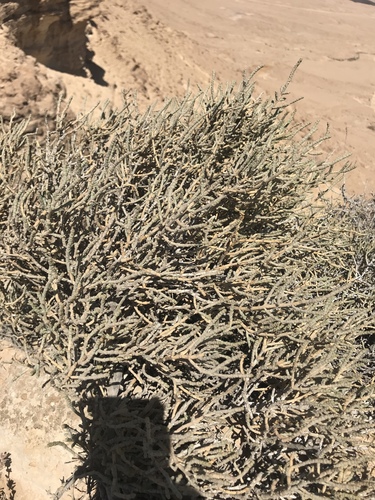
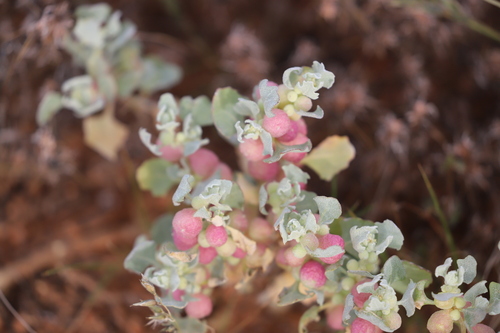
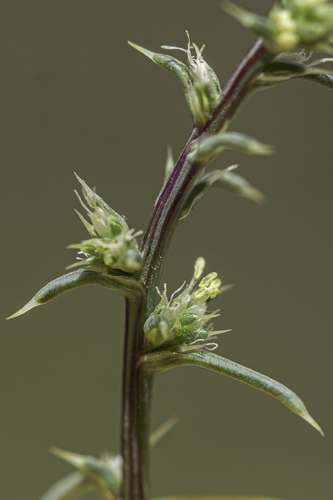
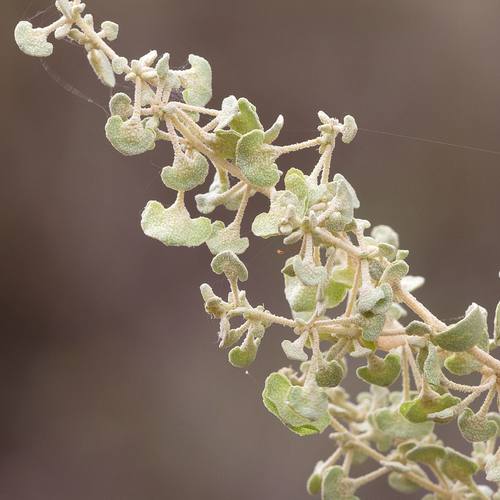
Atriplex stipitata Benth. is an erect, generally dioecious shrub that grows up to 1 meter (3.3 ft) tall. Its leaves are elliptic with smooth entire margins, and leaf tips are either obtuse or rounded. Leaf blades measure 7 to 25 mm in length, growing on petioles that are 2 to 3 mm long. Male flowers grow in disjunct spikes, while well-spaced clusters of female flowers form slender spikes. Bracteoles surround a superior ovary, which sits on a slender stipe that reaches up to 1 cm long. A. stipitata typically flowers from spring through autumn. Its common name, kidney saltbush, comes from the kidney shape of its fruits, and the distinctive fruits make the species easy to identify when they are in season. In 2020, N.G.Walsh & Sluiter described a subspecies of A. stipitata, Atriplex stipitata subsp. miscella. Unlike the typically dioecious autonymic subspecies, this subspecies is monoecious. It is distinguished by finer stems and narrower leaves, and is an erect, gracile shrub that is less robust than the dioecious autonymic taxon and has a shorter lifespan. Subsp. miscella grows 60 to 100 centimeters (24 to 39 in) tall with sparser stems, forming a more narrow shrub than Atriplex stipitata subsp. stipitata, which is often wider than it is tall. A. stipitata is widely distributed across Australia, occurring in all mainland Australian states. It is most abundant in the semi-arid and arid zones of inland South Australia and western New South Wales. While it can grow in a wide range of habitats, it occurs predominantly in the mallee region of Victoria and South Australia, and in open wooded areas. In south-western Western Australia, subsp. stipitata is common, while subsp. miscella is very rare, with only a single collection on record. In the Northern Territory, subsp. miscella is the more common of the two subspecies, and both are found in the southern regions of the territory. In South Australia, subsp. stipitata occurs across all mainland regions except the south-east, while subsp. miscella is currently restricted to the Flinders Ranges and Murray Mallee regions. In Queensland, subsp. miscella is the more common of the two subspecies, though both are relatively rare in the state, occurring only in the Warrego Pastoral District. In western New South Wales, the two subspecies have similar distributions. In Victoria, subsp. stipitata is found in the far north-west and near Bacchus Marsh, while subsp. miscella is restricted to the far north-west. Seeds of A. stipitata can be distributed worldwide, and the species has been introduced to the California coastline in the United States to help rehabilitate saline soils. A. stipitata prefers saline soils, including clay loam and coarse-textured soils. It is often found in areas with solonized brown soils that are high in calcium and magnesium carbonate, and it thrives in eroded red soils when competition from other species is low. Atriplex stipitata subsp. stipitata is more frequently found in mixed chenopod shrublands and has a stronger affinity for saline soils, while subsp. miscella is more commonly found in open woodlands. A. stipitata survives well in dry degraded soils, and has been recorded growing on creek banks, stony flats, slopes, ridges, flat plains, and outwash plains.