About Atriplex holocarpa F.Muell.
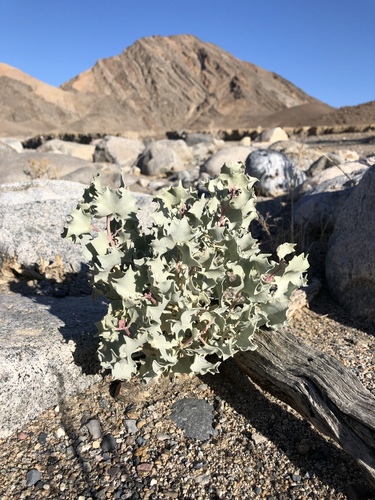
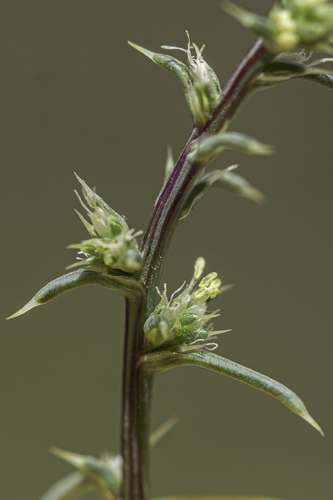
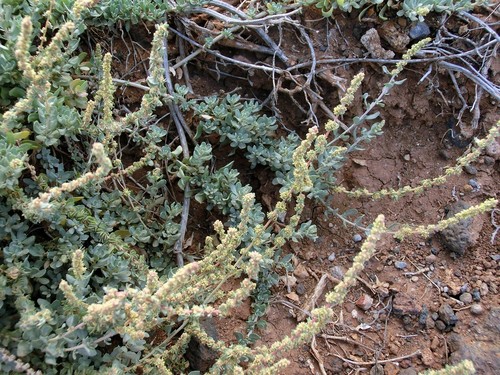
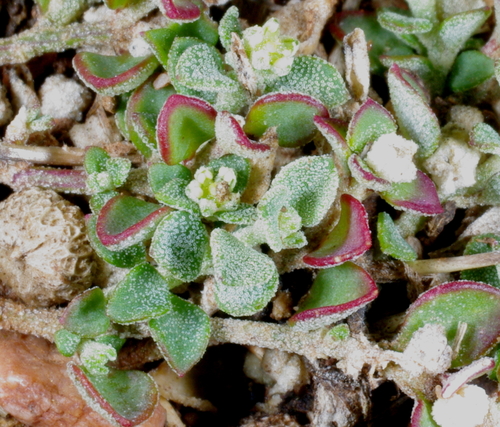
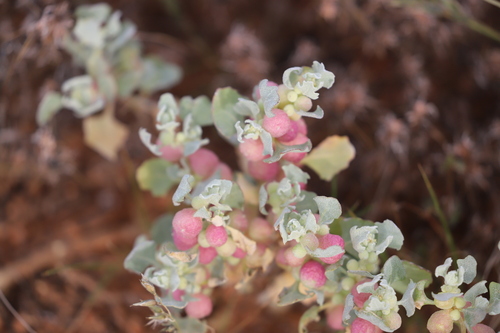
Atriplex holocarpa F.Muell. is a small, short-lived forb that grows between 10 and 30 cm tall. This species has small, broadly ovate silvery green leaves with irregularly notched margins, which turn purplish when they reach maturity. Atriplex holocarpa is monoecious, meaning it produces small separate male and female flowers on the same individual plant: male flowers grow in small clusters in the upper leaf axils, while female flowers grow in the lower leaf axils. Its fruits are globular and pear-shaped, ranging in color from greenish-white to reddish. They are membranous, net-veined or crinkled, and measure between 6 and 12 mm long. Atriplex holocarpa often grows alongside A. spongiosa, and can be distinguished from that species by key features: A. spongiosa has smaller fruiting bodies (4-6 mm long) and no or very short leaf stalks, while A. holocarpa has fruiting bodies 6-12 mm long and leaves with conspicuous stalks. Atriplex holocarpa is an Australian saltbush species that occurs in all Australian states except Tasmania. It is found in arid inland areas extending from southwestern Queensland, western New South Wales, and northwestern Victoria through to southern Western Australia, most often growing on floodplains or sandy flats. It is a halophyte with high tolerance for saline conditions, and grows in saline drainages and saline rocky hills, but never grows on sand. It can be sown on saline tailings dams and the slopes of saline waste dumps. Halophyte saltbushes of the genus Atriplex, in the family Chenopodiaceae, are ancient elements of Australia's arid flora. Dry temperate flora was already established in Australia 60 to 70 million years ago, when Australia was still connected to the Antarctic southern continent, and these Atriplex saltbushes have no close relatives in wetter parts of Australia. Atriplex holocarpa germinates readily in pits created by foraging desert animals including bilbies, echidnas, bettongs, and goannas, as well as introduced burrowing animals. It inhabits arid, temperate regions of Australia. Emus feed on its leaves during the summer months, but most animals find the species unpalatable and only consume it when no other food is available. The presence of this small forb indicates poor rangeland conditions, as its population increases when grazing pressure rises, due to its general unpalatability to most grazing animals. After setting seed, the seedcase of A. holocarpa develops a lemon-shaped or globular spongy mass around the seed. When mature, the seed cases turn blackish and fall to the ground. Because it is highly tolerant of saline conditions, A. holocarpa can be used to help colonize saline waste dumps. It extrudes salts through its vesiculated hairs to prevent salt from accumulating to toxic levels inside plant tissues. A. holocarpa has unicellular salt bladders on both upper and lower surfaces of its leaves; these bladders concentrate salt above the saturation point of NaCl, which is then released to the exterior through the vesiculated hairs.