About Atriplex cinerea Poir.
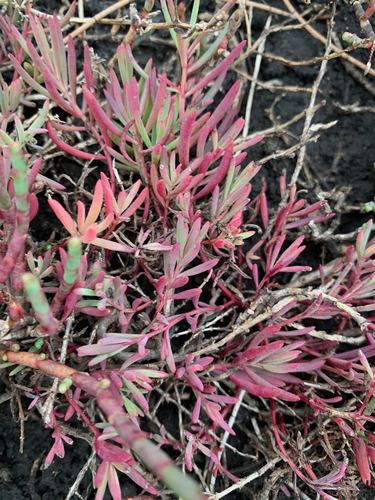
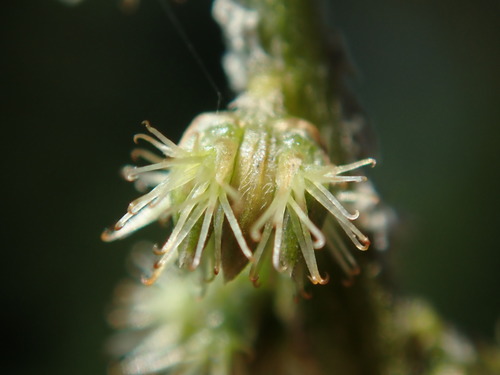
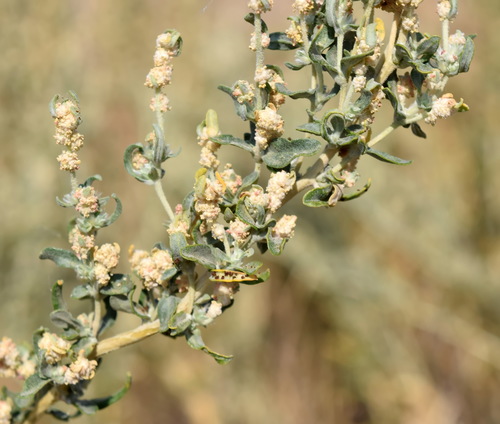
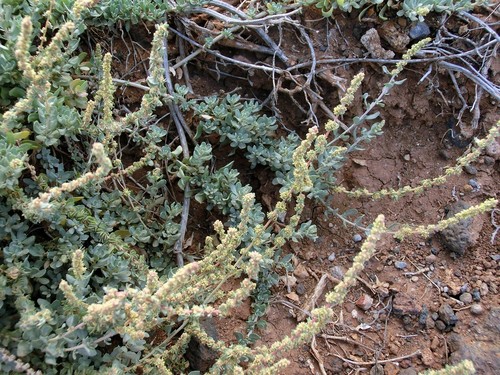
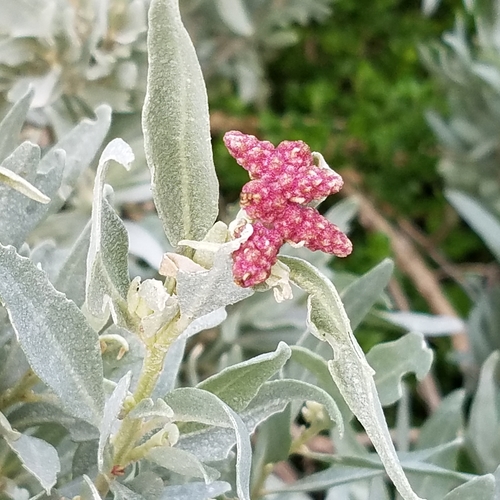
Atriplex cinerea Poir. is a prostrate to erect, heavily branched, leafy shrub that reaches up to 1.8 meters in height and up to 2.5 meters in width. Young stems are ridged and angular, and become woody as they age. Its leaves are alternately arranged, elliptic to oblong, silver or grey-green, up to 40 mm long and 15 mm wide, with 1–3 mm petioles. The entire plant is covered with bladderlike hairs. This species can be monoecious or dioecious. Male flowers form purple globular clusters that appear yellow when in bloom, arranged on simple or branched spikes; unbranched florets attach directly to the stem, and male flowers lack bracts or bracteoles. Female flowers bloom more discretely in leaf axils, with no perianth and 2mm diameter bracteoles; visible female flowers appear as two small pink tepals. Flowering occurs from September to March, and fruiting occurs from October to January.
Atriplex cinerea thrives in coastal environments. It is native to Victoria, Australia, but has become naturalised in some parts of the state. It is a halophyte with very high salt tolerance, and compared to other coastal species such as Banksia integrifolia, Leptospermum laevigatum, and Melaleuca lanceolata, it often grows closest to the sea in the harshest coastal conditions. It can colonize sand dunes despite strong prevailing winds and sea spray. It grows on nutrient-poor soils that can be highly alkaline, when the sand is composed of calcium carbonate. Its ability to survive in this harsh environment comes from multiple adaptations, including epidermal bladder cells that sequester salt from vascular tissue or the cell interior, and C4 photosynthesis, a trait common to many species in the genus Atriplex.
This species has a strongly coastal distribution. According to the Atlas of Living Australia, more than 95% of recorded Australian occurrences of Atriplex cinerea are located on the coast. It is found in Western Australia, South Australia, Victoria, New South Wales, Tasmania, and the Bass Strait Islands, and establishes on coastal sandy soils, with a particular preference for bays and inlets such as Western Port Bay and Port Phillip Bay. Its natural range and population density have declined as major Australian cities including Melbourne, Sydney, and Adelaide and their surrounding suburbs have expanded along the coast. Its presence on Bass Strait Islands suggests the species had a wider distribution when global sea levels were lower. It also occurs outside of mainland Australia, with a very restricted distribution on Lord Howe Island, and a presence in New Zealand. In the past, Atriplex cinerea was classified as an adventive species in New Zealand, but a more recent study has accepted it as a vagrant indigenous species to New Zealand. The study notes the most likely method of seed dispersal is movement of fruits via near-shore currents; Atriplex cinerea bracteoles can float in salt water for 18–30 days, and seeds germinate more easily after being washed in fresh water following immersion in salt water. The study concluded that "A. cinerea has always been scarce, its ability to successfully establish here has been hindered by its dioecious habit... its scarcity within New Zealand is primarily a natural rather than induced phenomenon."
Humans and local councils often use Atriplex cinerea to stabilise soils, prevent erosion, and revegetate or rehabilitate at-risk coastal areas. Species in the genus Atriplex are particularly useful for dryland salinity management, as they can alter water table levels and surface soil characteristics, making it possible for other plants to colonize the area. Joseph Maiden’s 1889 book *The Useful Native Plants of Australia* records that Atriplex cinerea was once used as a pot-herb in New South Wales. During his overland journey to Port Essington, explorer Ludwig Leichhardt used a species of Atriplex as a vegetable and spoke very highly of it. Studies on other closely related Atriplex species have explored their potential for agricultural use. A study of Atriplex nummularia found the species has a nitrogen content of 2.5-3.5%, and could potentially be used as a protein supplement for grazing if it is palatable. A later study let sheep and goats voluntarily feed on Atriplex halimus to test its palatability and nutritional value as a diet supplement. The study found that when goats and sheep can eat as much Atriplex halimus as they want, they do get enough nutritional benefit to supplement their diet, unless the animals have higher nutrient requirements during pregnancy and milk production. Since Atriplex cinerea is closely related to both Atriplex halimus and Atriplex nummularia, it is presumed to share similar biochemical properties, and therefore also has potential for agricultural use.