About Atretium schistosum (Daudin, 1803)
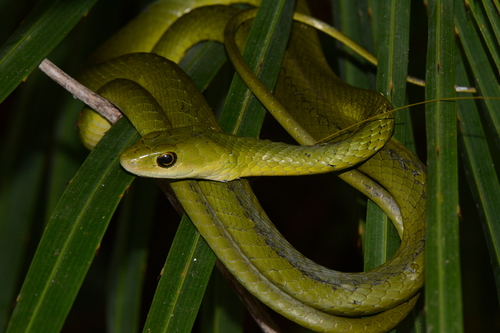
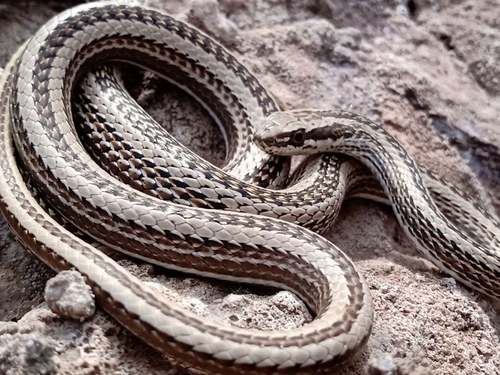
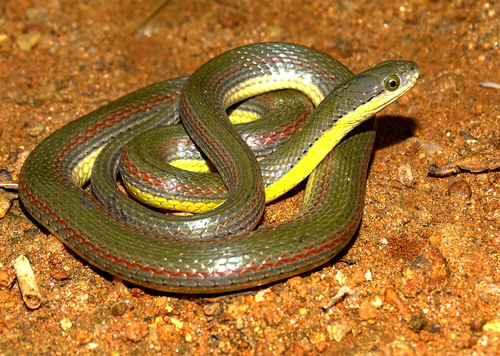
Atretium schistosum is a small, robust snake species with a thin head, short snout, and slit-shaped nostrils positioned relatively high on the snout. Its dorsal body is olive-green, while its ventral surface ranges from yellow to orange; flanks are sometimes tinged with pink or purple. The tail makes up between one-fourth and one-third of the snake’s total body length. Its dorsal scales are rough due to being keeled. Specimens collected from South India have a distinct reddish stripe along the 4th and 5th or 5th and 6th scale rows that extends to the vent; this stripe is brighter in male individuals. Adult females measure 70 to 75 cm in total length, while adult males measure 50 to 60 cm; the longest recorded individual of this species reaches 87 cm in total length. This species can be identified by a consistent set of scale traits: it has a single internasal scale, 19 rows of costal scales, and 8 or 9 supralabial upper lip scales. It can be easily confused with the olive forest snake Rhabdops olivaceus. Atretium schistosum is distributed across Sri Lanka, India, Bangladesh, and Nepal. Within India, it occurs in peninsular India south of 15 degrees north latitude, and along the east coast as far north as Uttarakhand. It is reported to be very common in the areas around Bangalore, North Arcot district in Tamil Nadu, and the Kakinada area in Andhra Pradesh. This species occurs at elevations up to 1000 m (3280 ft) above sea level, and is absent from most of North India. Atretium schistosum is oviparous, meaning it reproduces by laying eggs. It breeds during the monsoon season. Females lay clutches of 10 to 32 eggs between January and April; the eggs are white, soft-shelled, and measure 30 to 35 mm (1.2–1.4 in) in length. Newly hatched individuals of this species measure 16.6 to 17.5 cm (6.5–6.9 in) in total length.