About Atractus crassicaudatus (Duméril, Bibron & Duméril, 1854)
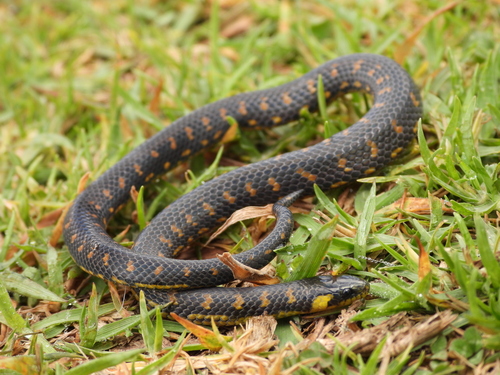
This species, commonly called the thickhead ground snake, has dark purplish-brown to blackish coloration on both its dorsal (upper) and ventral (lower) surfaces. Small yellowish spots appear on the dorsal side, while the ventral side has larger yellowish spots. The first row of dorsal scales along each side, adjacent to the ventral scales, is yellowish, and each temple has a distinct yellowish blotch. The snake has an obtuse snout. Its rostral scale is small, and the internasal scales are very small; the prefrontal scales are as long as they are broad. The frontal scale is as long as or slightly longer than it is broad, matching the length of the distance from the frontal scale to the tip of the snout, and is much shorter than the parietal scales. The loreal scale is at least twice as long as it is tall. This species has two postocular scales, with temporal scale arrangement of 1+2. It most often has seven upper labial scales (rarely six); the third and fourth (or just the third, when only six upper labials are present) enter the eye orbit. Three lower labial scales contact the single pair of chin shields. Dorsal scales are smooth and arranged in 17 rows. Ventral scales number between 146 and 161. The anal scale is undivided, and there are 19 to 27 paired subcaudal scales. Adult thickhead ground snakes reach a maximum total length of 42 centimeters (17 inches), with a tail length that makes up roughly one-tenth of the total body length. The species is endemic to the Altiplano Cundiboyacense, occurring at elevations between 2,000 and 3,200 metres (6,600 and 10,500 ft). It is reported to be especially common around the Bogotá capital district, including the Eastern Hills of Bogotá and Lake Herrera on the Bogotá savanna.