About Atractocarpus fitzalanii (F.Muell.) Puttock
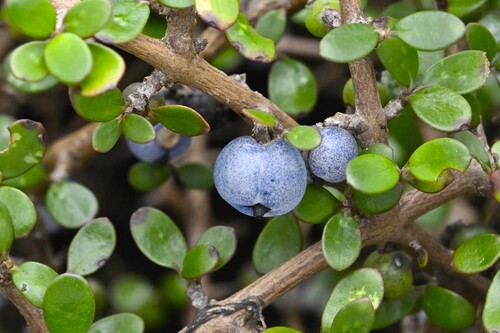
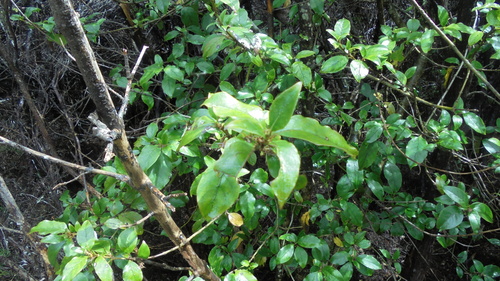
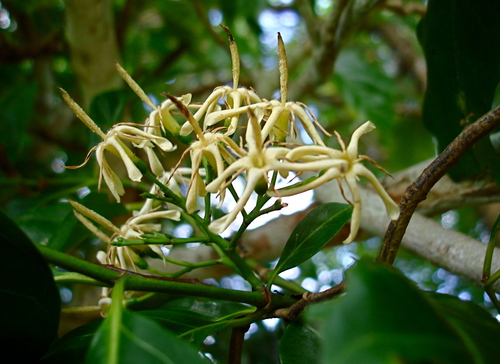
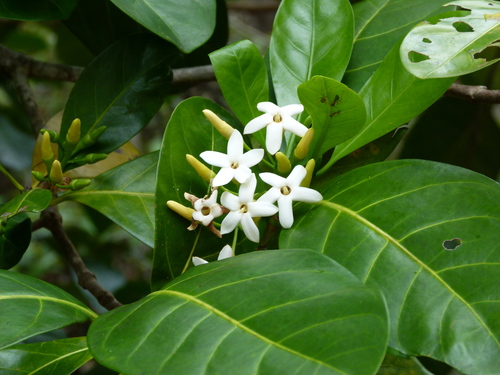
Atractocarpus fitzalanii, commonly called the brown gardenia, is a woody shrub or small tree. It most often grows up to 3 m wide and 8 m high, though it may occasionally reach 20 m in height, and has a smooth grey trunk that can be up to 35 cm in diameter. Its large leaves are obovate to oval-shaped, growing up to 20 cm long by 10 cm wide, and are carried on petioles up to 3 cm long. Leaves are arranged oppositely along stems; they are glossy dark green on the upper surface and dull grey-green on the lower surface. The lateral veins occur in 6–7 pairs, and sit at an angle of 50°–70° from the midrib. New growth of this species is bright lime green. Brown gardenia is dioecious, meaning male and female flowers grow on separate individual plants. Inflorescences take the form of panicles, produced either at the end of stems or in leaf axils. Male panicles hold 15–30 flowers, while female panicles hold up to 15 flowers. The flowers are fragrant, white, measure around 3 cm in diameter, and have a corolla tube about 1.5 cm long. The fruit is a globose drupe, yellow-brown in color, growing up to 10 cm long by 9 cm wide. Fruits of the nominate subspecies usually occur singly, and only rarely form clusters of 3–4. For the subspecies A. f. subsp. tenuipes, fruits are paler, smaller (up to 3.8 cm long by 3.5 cm wide), and are produced in clusters of 3–7. The calyx remains persistent at the apex of the fruit in both subspecies. A. f. subsp. fitzalanii is widespread across multiple forest types, including rainforest, monsoon forest, swamp forest, mangrove forest, and riparian forest. Its natural range extends from just south of Cooktown to just south of Mackay, and it occurs from sea level up to around 1,200 m in elevation. A. f. subsp. tenuipes occurs at higher elevations, between 500 and 1,500 m, and has a more restricted natural range: from near Cape Tribulation to the southern Atherton Tableland. Although weed potential for this species has not been formally studied in Australia, weed management staff from the Noosa Integrated Catchment Association have found brown gardenia growing regularly in bushland areas outside its natural native range. Birds disperse its seeds outside of cultivated settings, so this species carries a risk of becoming a weed in non-native regions such as Hawaii. A. f. subsp. fitzalanii flowers from October to February, and its fruits ripen between September and March. A. f. subsp. tenuipes flowers in October and November, and its fruits mature from May to August. Moths visit brown gardenia flowers shortly after they open. The fruits are eaten by a range of birds and animals, including the cassowary (Casuarius casuarius). Brown gardenia has horticultural potential for gardens in subtropical climates, valued for its bushy lush foliage, bright new growth, fragrant flowers, and edible, tasty fruit. It grows well in shady garden positions with good drainage, and also adapts to moderately to brightly lit indoor spaces. More than 280 brown gardenias have been planted as street trees in the city of Cairns.