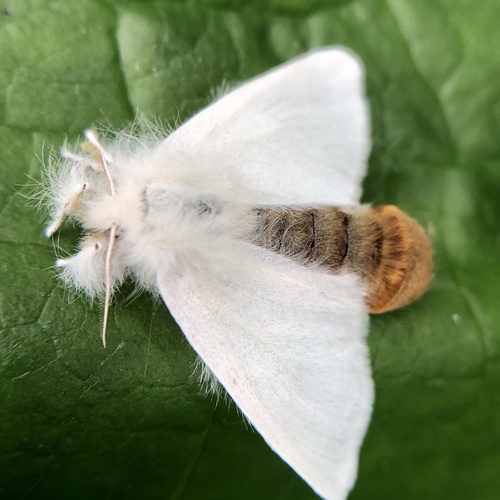
About Atolmis rubricollis (Linnaeus, 1758)
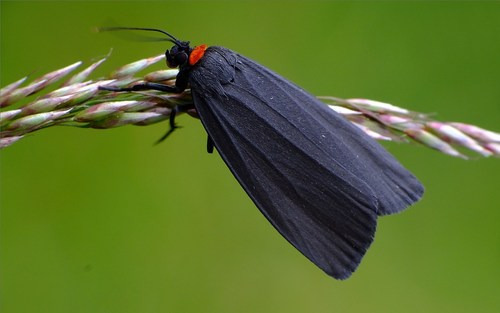
Atolmis rubricollis, commonly known as the red-necked footman, is a small moth. Most individuals are primarily charcoal grey or deep dark brown; fresh specimens are almost black. They have a distinct bright orange thorax, which appears as an orange-red collar behind the black head. Hindwings are brownish grey, antennae and legs are black, and the tip of the abdomen is yellowish orange or golden yellow. When at rest, the wings are tightly folded against the body, with pleated, squared-off wing tips. This moth has a wingspan of 25 to 35 mm (1.0 to 1.4 in), and forewings measure 15 to 18 mm (0.6 to 0.7 in) in length. Wilhelm Neuburger described lighter-colored Romanian specimens as the synonym Atolmis flavicollis; these individuals are less dark brown, with a pale yellow collar instead of a red one. The red-necked footman is distributed across Europe, ranging south to the Mediterranean and east across the Palearctic into temperate Asia. Its range extends through Siberia to the Amur River region and China. Within the British Isles, it occurs in parts of Ireland, and in the United Kingdom it has established breeding populations in south-western counties of England and Wales. Records from other parts of the United Kingdom are most likely accidental vagrants, not members of breeding populations. It is a woodland species that inhabits both deciduous and coniferous woodland, particularly favoring spruce trees, but may also be found on pine, oak, and beech. It prefers habitats near streams in cool wooded upland valleys. Female red-necked footmen lay white eggs in small clusters in crevices on tree branches, especially on the branches of old fir trees. Caterpillars feed on lichens that grow on tree trunks and branches, and can be found from August to October. Fully grown caterpillars reach a length of around 27 mm (1.1 in). They have a black head, with a bold diagonal white stripe running down each side. Their base body color is dark greenish grey, marbled with cream. Each body segment has six tiny reddish yellow warts covered with black hairs. Caterpillars pupate before winter arrives, and overwinter as glossy brownish red pupae inside a loose cocoon buried among moss and leaf litter. Adult moths fly between May and July, depending on their location. Adults are primarily nocturnal and are attracted to lights, but may occasionally fly during the day. While they sometimes feed on nectar from scabiouses and other flowers, they usually rest during the day on the long overhanging fir branches above woodland paths, where they can be collected by beating branches over a net.