About Atlides halesus (Cramer, 1779)
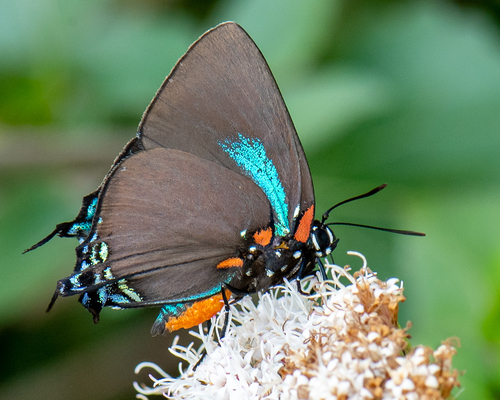
Adult Atlides halesus (the great purple hairstreak) have a wingspan ranging from 1.25 to 1.5 inches. Contrary to its common name, this butterfly has no purple coloration. The center of the wing upperside is iridescent blue, edged with a black border; males typically have more extensive and brighter blue wing coloration than females. The hindwings bear two sets of unequal-length tails, which give the species its "hairstreak" name. The wing underside is black, marked with orange-gold spots: one spot on each forewing, and two spots on each hindwing near the tails. The butterfly's abdomen has a blue upperside and an orange underside. Like many other butterfly species, the hindwing morphology of Atlides halesus mimics a head. The tails resemble butterfly antennae, and the orange spots on each hindwing resemble eyes, creating a "false head". When perching, the butterfly orients its body so that the tails point upward, the real head points downward, and it also moves its body back and forth. This hindwing morphology combined with the behavior draws predator attention toward the false head, deflecting attacks to the less vulnerable hindwings and letting the butterfly reduce damage to essential body regions.