About Atherurus africanus Gray, 1842
Common Name and Body Length
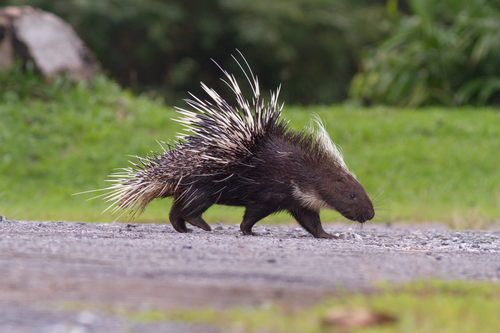
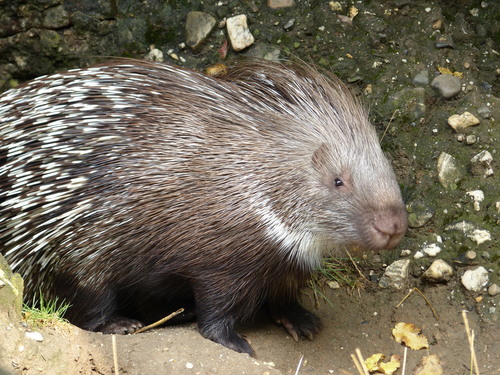
Atherurus africanus, commonly called the African brush-tailed porcupine, has a body length ranging from 40 to 50 cm, not including its tail.
Adult Weight
Adult individuals of this species weigh approximately 3 kg.
Body and Limb Morphology
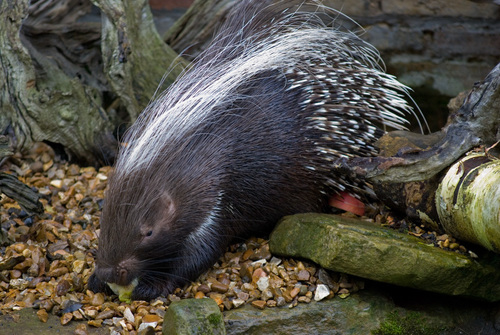
It has an elongated, rat-like face and body, paired with short legs that end in clawed, webbed feet.
General Quill Characteristics
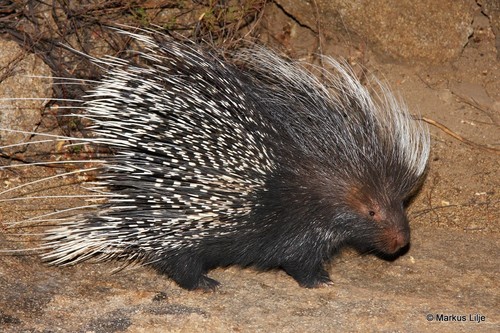
Unlike the quills of most other porcupine species, the quills of the brush-tailed porcupine are light and small.
Tail Quill Function
The quills on its tail are thinner and shaped like a brush; when rattled, these tail quills produce audible noise.
Geographic Distribution
This porcupine is distributed across Benin, Cameroon, Congo, the Democratic Republic of Congo, Equatorial Guinea, Gabon, Gambia, Ghana, Guinea, Ivory Coast, Kenya, Liberia, Nigeria, Sierra Leone, South Sudan, Togo and Uganda.
Habitat Altitude Range
It inhabits tropical rainforest at altitudes up to 3,000 m (9,800 ft).
Social Group Structure
Brush-tailed porcupines live in small family groups of around eight members, and different family groups may share resources.
Anti-predator Behaviors
When threatened by a predator, the porcupine raises its quills to appear roughly twice its original size, rattles its tail quills, and stomps its feet. Like all porcupines, it will back into an attacker to inflict damage with its quills.
Activity Pattern and Daytime Shelter
This species is nocturnal, and sleeps in caves and burrows during the day.
Preferred Habitat
It lives in forests, most commonly at high elevations.
Primary Diet
The brush-tailed porcupine is primarily herbivorous, feeding on fallen leaves, flowers, and fruits found on the forest floor.
Opportunistic and Crop Feeding
It also consumes roots and palm nuts, occasionally eats carrion, and will invade adjacent maize, cassava, and banana crops grown near forest edges.
Breeding Pair Bonds
During the breeding season, males and females form pair bonds.
Gestation Period
Compared to other rodent species, female brush-tailed porcupines have a long gestation period that can last up to 110 days.
Offspring Development
Their offspring are born well-developed, or precocial.
Sexual Maturity Age
Young porcupines reach sexual maturity at approximately 2 years of age.
Human Use
The meat of the brush-tailed porcupine is popular and is consumed in large volumes by local human populations.